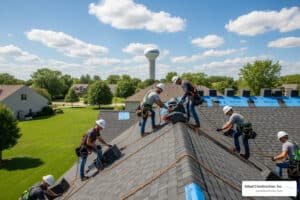

Why Commercial Roofing Naperville Demands Specialized Expertise
Commercial roofing Naperville requires contractors who understand DuPage County weather loads, low-slope drainage design, and local permitting. For businesses evaluating service in Naperville, the most important point is this: a commercial roof is a building system, and performance depends on material selection, correct detailing, and consistent inspections.
If you need a local team for commercial roofing in Naperville, start with experienced Illinois roofing contractors who routinely manage commercial safety requirements, staging, and code compliance.
Key Commercial Roofing Services in Naperville:
- Installation and Replacement – TPO, EPDM, PVC, and metal systems for flat and low-slope roofs
- Roof Restoration – Coatings that can extend service life 10-15 years when the roof is structurally sound
- Emergency Repair – Rapid response for active leaks and storm damage
- Preventative Maintenance – Spring and fall inspections to find issues early
- Code Compliance – DuPage County permit coordination and inspection support
Naperville roofs face freezing winters, spring hail and wind, and summer heat. Those cycles stress seams, flashings, and insulation. Industry studies consistently show that many commercial tear-offs occur before the roof system is beyond repair, which is why a professional assessment should compare repair vs restoration vs replacement using objective findings (moisture scans, core samples when needed, and documented leak mapping).
I’m Gerald Michaels, founder and president of Adept Construction, Inc., and our family-owned team has delivered commercial roofing solutions across Chicago’s West Suburbs since 1997. We focus on clear documentation, durable details at penetrations and edges, and maintenance plans that reduce emergency calls.
Contact us for a free estimate and a clear recommendation based on the condition of your existing system.
Commercial roofing Naperville terms explained:
The Landscape of Commercial Roofing in Naperville
Naperville’s climate is characterized by extreme temperature fluctuations, heavy snow loads, and high-wind events that demand robust structural integrity. Commercial roofs in this region must withstand wind gusts up to 60 mph and frequent freeze-thaw cycles that can compromise standard materials. Professional roofing contractors in Illinois provide the specialized expertise required to steer DuPage County building codes and local environmental stressors.
What are the primary challenges of commercial roofing in Naperville’s climate?
Naperville’s weather is a formidable opponent for any commercial roof. We see long, humid summers with scorching heat and freezing, windy winters that bring heavy snow. This creates a unique set of challenges:
- Heavy Snow Loads: The accumulation of snow and ice puts immense stress on commercial roof structures. This requires roofing systems designed to handle significant weight and proper drainage to prevent ponding water when the snow melts.
- Freeze-Thaw Cycles: The constant freezing and thawing of moisture can cause materials to expand and contract, leading to cracks, membrane deterioration, and compromised seals. This is a major factor in roof degradation in Naperville.
- High Winds: Naperville experiences wind gusts up to 60 mph yearly, especially during spring and fall storms. These strong winds can lift shingles, peel back membranes, and exacerbate existing damage. Our roofs need to be anchored securely to resist these forces.
- Hail Damage: With an average of 3-4 hail events annually, commercial roofs are constantly at risk of impact damage, which can lead to punctures, granule loss, and hidden structural issues.
- UV Exposure: Intense summer sun, combined with reflective surfaces, can accelerate the aging process of roofing materials, making them brittle and less effective over time.
These climatic conditions directly impact commercial roofing choices, pushing us towards materials and installation methods that offer superior resistance and longevity.

For immediate assistance with storm-related roof issues, please remember that prompt action is critical. Get Storm Damage Roof Repair Help as soon as you notice damage.
How do local building codes and permitting processes in Naperville affect commercial roofing projects?
Navigating local building codes and permitting is a crucial aspect of any commercial roofing project in Naperville. Commercial buildings must adhere to specific local regulations to ensure structural integrity, safety, and energy efficiency. These codes often dictate:
- Material Requirements: Certain materials might be preferred or mandated for specific building types or zones.
- Insulation Standards: Energy efficiency codes often require specific R-values for insulation, impacting material choices and installation methods.
- Drainage Systems: Strict guidelines are usually in place for roof drainage to prevent ponding water and manage stormwater runoff.
- Safety Protocols: OSHA safety compliance and local safety regulations are paramount during installation, requiring proper equipment and trained personnel.
Our team is intimately familiar with Naperville’s building codes and permitting processes. We handle all necessary permits and coordinate inspections, ensuring your project is fully compliant and hassle-free. This local expertise saves you time, prevents costly delays, and guarantees that your new or repaired roof meets all required standards.
Common Systems and Materials for Naperville Businesses
Selecting the right material is the most critical factor in determining a roof’s long-term ROI and energy efficiency. While residential properties often rely on shingles, commercial structures require high-performance membranes like TPO, EPDM, or PVC to manage large surface areas and complex drainage needs. Understanding the characteristics of different roofing systems is key.
What are the most common types of commercial roofing materials used in Naperville and their pros/cons?
In Naperville, commercial properties frequently use several high-performance roofing materials, each with distinct advantages and disadvantages custom to specific business needs and building designs. Here’s a breakdown of the most common types:
TPO and EPDM: The Standard for Commercial Roofing Naperville
These single-ply membranes are incredibly popular for flat or low-slope commercial roofs, which are prevalent in Naperville.
- TPO (Thermoplastic Polyolefin):
- Pros: Highly durable, energy-efficient (often white, reflecting UV rays and reducing cooling costs), cost-effective, and heat-welded seams provide superior watertight protection. It’s resistant to punctures and tears.
- Cons: Can be susceptible to certain chemicals and may become brittle in extremely cold temperatures if not formulated properly.
- EPDM (Ethylene Propylene Diene Monomer):
- Pros: Known as “rubber roofs,” EPDM is extremely durable, long-lasting (often 20-30+ years), flexible in cold temperatures, and highly resistant to UV radiation and weathering. It’s a cost-effective choice for long-term performance.
- Cons: Primarily available in black, which can absorb heat, potentially increasing cooling costs unless coated. Seams are sealed with adhesive, which can be less robust than heat-welded seams if not carefully applied.
Metal and Modified Bitumen Options
For certain commercial applications, especially those with unique aesthetic requirements or specific performance needs, other materials shine.
Standing-Seam Metal:
- Pros: Exceptional longevity (50+ years), highly durable against weather extremes, fire-resistant, energy-efficient (especially with cool-roof coatings), and offers a modern, aesthetic appeal. Its interlocking panels are excellent for drainage.
- Cons: Higher initial cost, can be noisy during rain or hail, and requires specialized installation.
Modified Bitumen:
- Pros: A multi-layer system that offers excellent waterproofing, puncture resistance, and durability, especially in high-traffic areas. It’s an upgrade from traditional Built-Up Roofing (BUR) with added polymers for flexibility.
- Cons: Can be more labor-intensive to install (torch-applied or cold-applied), and its dark color can absorb heat.
- PVC (Polyvinyl Chloride):
- Pros: Similar to TPO, PVC is a single-ply membrane known for its exceptional resistance to chemicals, grease, and moisture, making it ideal for restaurants or industrial kitchens. It’s also heat-welded for strong seams and often reflective.
- Cons: Generally more expensive than TPO or EPDM, and can be less flexible in extreme cold.
For detailed information on these systems and more, explore our flat roofing services.
Here’s a quick comparison of these common commercial roofing materials:
| Material | Pros | Cons | Typical Lifespan | Energy Efficiency | Chemical Resistance |
|---|---|---|---|---|---|
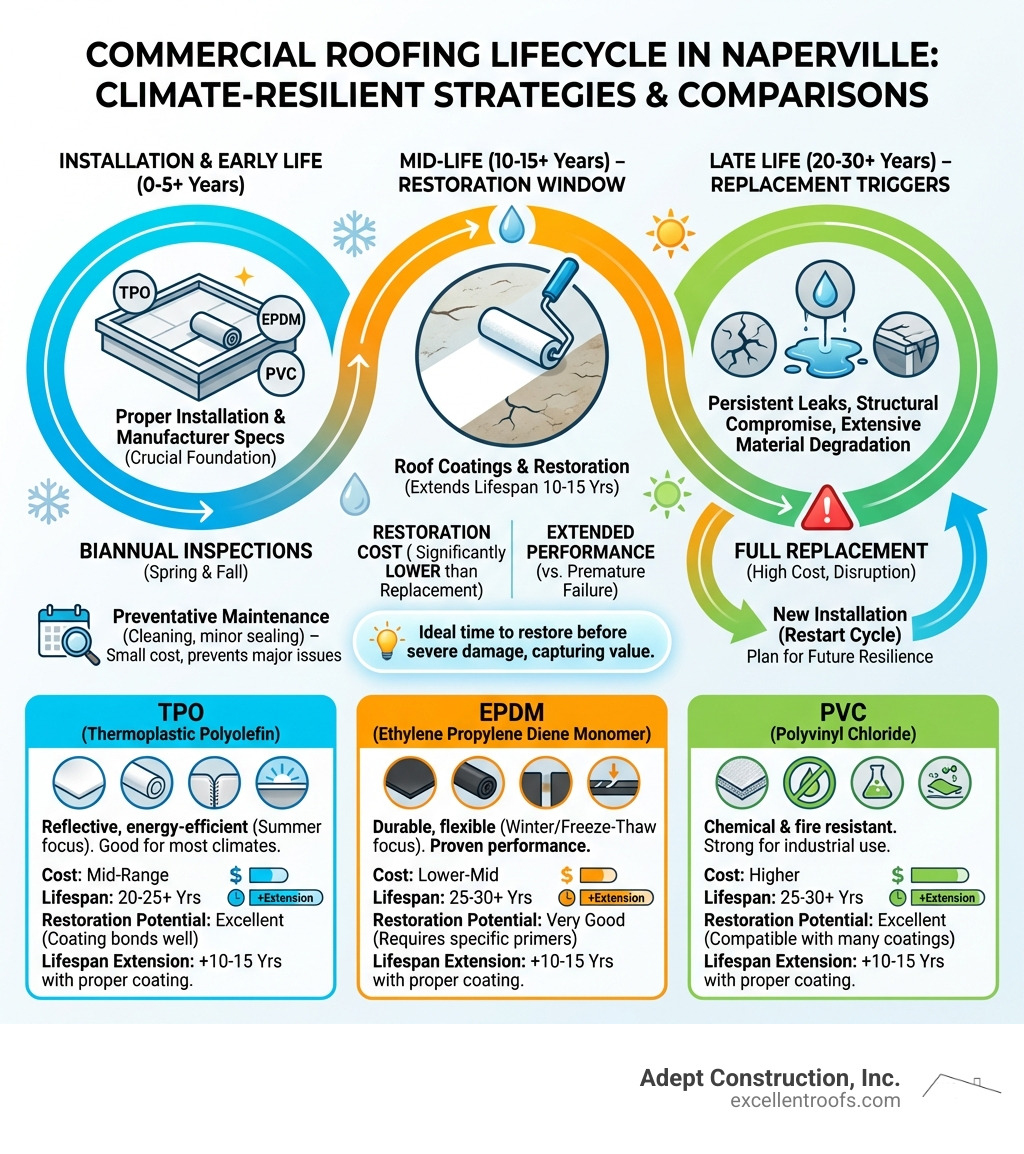
| TPO | Durable, energy-efficient, cost-effective, heat-welded seams | Can be susceptible to some chemicals, may become brittle in extreme cold | 15-20+ years | High | Moderate |
| EPDM | Extremely durable, long-lasting, flexible in cold, UV resistant, cost-effective | Primarily black (absorbs heat), adhesive seams | 20-30+ years | Moderate | Moderate |
| PVC | Exceptional chemical/grease/moisture resistance, heat-welded seams, often reflective | Higher initial cost, less flexible in extreme cold | 20-30+ years | High | High |
| Metal | Exceptional longevity, durable against weather, fire-resistant, aesthetic, excellent drainage | Higher initial cost, can be noisy during rain/hail, specialized installation | 40-60+ years | High | High |
| Modified Bitumen | Excellent waterproofing, puncture resistance, durable, good for high-traffic areas | More labor-intensive installation, dark color absorbs heat | 15-20+ years | Moderate | Moderate |
How does Naperville’s climate specifically impact commercial roofing choices?
Naperville’s climate is a primary driver in selecting the optimal commercial roofing system. The significant temperature swings, intense UV exposure, and potential for severe weather events (snow, hail, high winds) mean that materials must be robust and versatile.
- Energy Efficiency: With hot summers, reflective “cool roofs” like white TPO or PVC, and light-colored metal roofs, are highly advantageous for reducing cooling costs. High-R insulation values are also crucial for both summer cooling and winter heating efficiency.
- Durability and Flexibility: Materials that remain flexible in freezing temperatures, like EPDM, are preferred to prevent cracking and splitting. Systems with strong seam integrity, such as heat-welded TPO and PVC, are essential to resist wind uplift and moisture penetration during heavy storms.
- Drainage: The risk of heavy snowfall and spring rains makes proper drainage design paramount. Roofing systems that facilitate efficient water runoff are critical to prevent ponding water, which can lead to premature roof failure and structural damage.
- Wind Resistance: Given the frequent high winds, systems must be securely fastened and designed to prevent membrane detachment or shingle blow-off.
Our local expertise means we recommend and install systems that are proven performers against Naperville’s specific environmental stressors, ensuring your investment is protected for decades.
Maintenance, Repair, and Restoration Strategies
Commercial roof performance is predictable: roofs fail fastest when small defects at seams, penetrations, and edges are left uncorrected. Restoration and targeted repairs are often viable when the existing roof is dry, adhered, and structurally sound. High-solid silicone or elastomeric coatings can add 10-15 years of service life by renewing waterproofing and UV protection without a full tear-off.
What is the typical lifespan of a commercial roof in Naperville, and how can it be extended?
With correct installation and consistent inspections, common commercial systems in Naperville (including TPO and EPDM) routinely deliver 20 to 30 years of reliable service. Metal systems often exceed 40 to 60 years. Lifespan depends on material quality, installation quality, and maintenance frequency.
To extend service life in Naperville conditions:
- Schedule biannual inspections in spring and fall to verify membrane condition, flashings, and roof-top equipment details.
- Repair small defects immediately to prevent wet insulation and deck damage.
- Use restoration strategically when the roof is a good candidate and moisture is not trapped in the assembly.
For leak response and corrective work, start with professional roof repair in Naperville, IL so the cause is fixed, not just the symptom.
What are the benefits of preventative maintenance for commercial roofs in Naperville?
Preventative maintenance reduces lifecycle cost and protects interior assets. These outcomes are consistent across major commercial roof types:
- Longer roof life: Regular inspections and minor repairs delay replacement.
- Lower total cost: Planned repairs are less expensive than emergency leak work and interior remediation.
- Better energy performance: Intact membranes and dry insulation preserve thermal performance.
- Fewer disruptions: Predictable maintenance reduces business downtime.
- Warranty protection: Many manufacturer warranties require documented maintenance.
- Improved safety: Addressing loose flashings and deterioration reduces hazard risk.
What are the benefits of roof coatings and restoration for Naperville businesses?
Roof coatings and restoration are best used when the existing roof is still structurally sound.
- Cost-effective: Restoration typically costs less than a full tear-off.
- Added service life: Coatings can add 10-15 years when applied to a qualifying system.
- Less disruption: Many restorations can be completed faster than replacement.
- Energy savings: Reflective coatings can reduce roof surface temperatures and summer cooling demand.
- Less waste: Restoration reduces landfill disposal compared to tear-off.
What are the signs that a commercial roof needs repair versus replacement?
Use the condition of the assembly to make the decision.
Signs a commercial roof usually needs repair or restoration:
- Isolated leaks tied to a specific flashing or penetration
- Localized punctures or membrane cuts that have not spread
- Minor seam or edge detail failures that can be corrected
- Small areas of cracking or blistering with dry insulation
Signs a commercial roof often needs replacement:
- Multiple leak areas across the building (systemic failure)
- Wet or saturated insulation confirmed by testing
- Widespread membrane deterioration (shrinking, splitting, delamination)
- Structural issues such as deck deterioration or unsafe deflection
- End-of-life age combined with recurring repairs
If a storm creates active leaks, start with storm documentation and immediate dry-in. Use Adept Construction, Inc. for commercial inspection and scope development, and visit our Naperville service area page for scheduling: https://excellentroofs.com/service-area/naperville-il/.
Contact us for a free estimate and an evidence-based recommendation (repair, restoration, or replacement).
Navigating Costs, Codes, and Contractor Selection
Commercial roofing budgets are driven by roof assembly design and job logistics, not square footage alone. In Naperville, the biggest cost levers are insulation thickness (R-value), tear-off requirements, the number of penetrations, edge conditions, and access for staging. A well-scoped project includes code-compliant details, manufacturer-approved assemblies, and a documented plan for keeping the building watertight during construction.
What are the cost factors involved in commercial roofing projects in Naperville?
Commercial pricing is typically determined by these measurable drivers:
- Scope of work: Repair, restoration, recover, or full tear-off and replacement
- System type: TPO, EPDM, PVC, modified bitumen, or metal
- Insulation and cover board: Thickness, taper, and required R-value
- Penetrations and equipment: HVAC curbs, vents, skylights, and other details that require custom flashing
- Perimeter conditions: Parapets, copings, and edge metal requirements
- Access and staging: Height, crane needs, laydown area, and protection of pedestrian/tenant zones
- Deck condition: Any required deck repairs before the new system is installed
- Permits and inspections: Local permitting and required inspections
What types of warranties are typically offered for commercial roofing projects in Naperville?
Commercial warranties commonly include:
- Manufacturer warranties covering approved roof assemblies and materials for a defined term.
- Workmanship warranties covering installation-related defects.
When available, NDL (No-Dollar-Limit) warranties are valuable because coverage is not capped by a preset dollar amount for covered repairs.
What are the essential factors to consider when choosing a commercial roofing contractor in Naperville?
Select a contractor based on verifiable commercial capability:
- Local code familiarity: DuPage County permitting and inspection coordination
- Licensing and insurance: Current certificates and appropriate limits
- Manufacturer certifications: Proven ability to install specific systems to spec
- Commercial safety program: OSHA-aligned training, fall protection, and site controls
- Documentation: Photos, moisture findings (when applicable), and a clear scope
- Communication plan: Scheduling, daily updates, and leak-response procedures
- Warranty clarity: Written terms for both manufacturer and workmanship coverage
What are the advantages of hiring a local Naperville commercial roofing company?
Local service improves outcomes because it reduces response time and improves compliance.
- Faster emergency response after wind, hail, or heavy snow events
- Better permitting efficiency through familiarity with local processes
- Accountability and accessibility for follow-up and warranty service
To schedule commercial service in Naperville, use our local page: https://excellentroofs.com/service-area/naperville-il/.
How can businesses minimize disruption during commercial roofing projects in Naperville?
Disruption control should be part of the scope, not an afterthought.
- Phased installation to keep critical areas protected
- Off-hours planning for loud work when feasible
- Staging plans that protect entrances and tenant traffic
- Daily cleanup and end-of-day dry-in to reduce risk of overnight leaks
- Clear safety zones and signage to protect employees and visitors
Contact Adept Construction, Inc. for a free estimate and a project plan built around maintaining operations while improving roof performance.
Frequently Asked Questions about Commercial Roofing
How often should a commercial roof in Naperville be inspected?
Inspect at least twice per year (spring and fall) and after major hail or high-wind events. This schedule is the most reliable way to catch seam, flashing, and drainage issues early, protect warranties, and reduce emergency leak risk.
What is the typical lifespan of a commercial roofing system?
Most commercial single-ply systems such as TPO and EPDM last 20 to 30 years when properly installed and maintained. Metal systems often exceed 40 to 60 years. The deciding variables are installation quality, detail quality at penetrations/edges, and whether the roof stays dry.
Can a roof coating be applied to any commercial roof?
No. Coatings are appropriate only when the existing roof is structurally sound, dry, and well-adhered. If insulation is wet or the deck is compromised, replacement is usually required. A professional inspection should confirm eligibility before any restoration is proposed.
Conclusion
Commercial roofing in Naperville is a risk-management decision: the right system and maintenance plan protect operations, inventory, and long-term building value. Adept Construction, Inc. delivers commercial inspections, repairs, restorations, and replacements with a focus on documentation, code compliance, and high-quality workmanship.
For local scheduling and service details, visit our Naperville page: https://excellentroofs.com/service-area/naperville-il/.
Contact us today for a free estimate and a clear, evidence-based recommendation for your commercial roof.