
Why Residential Roof Ventilation Is the Most Overlooked Part of Your Roof
Residential roof ventilation is a system of intake and exhaust vents that moves air through your attic to control heat and moisture — and it’s one of the most critical factors in how long your roof lasts. If you’re looking for a quick answer, here’s what you need to know:
At a glance — residential roof ventilation essentials:
- What it does: Removes heat and moisture from your attic space
- Code minimum: 1 sq. ft. of net free area (NFA) per 150 sq. ft. of attic floor space (IRC standard)
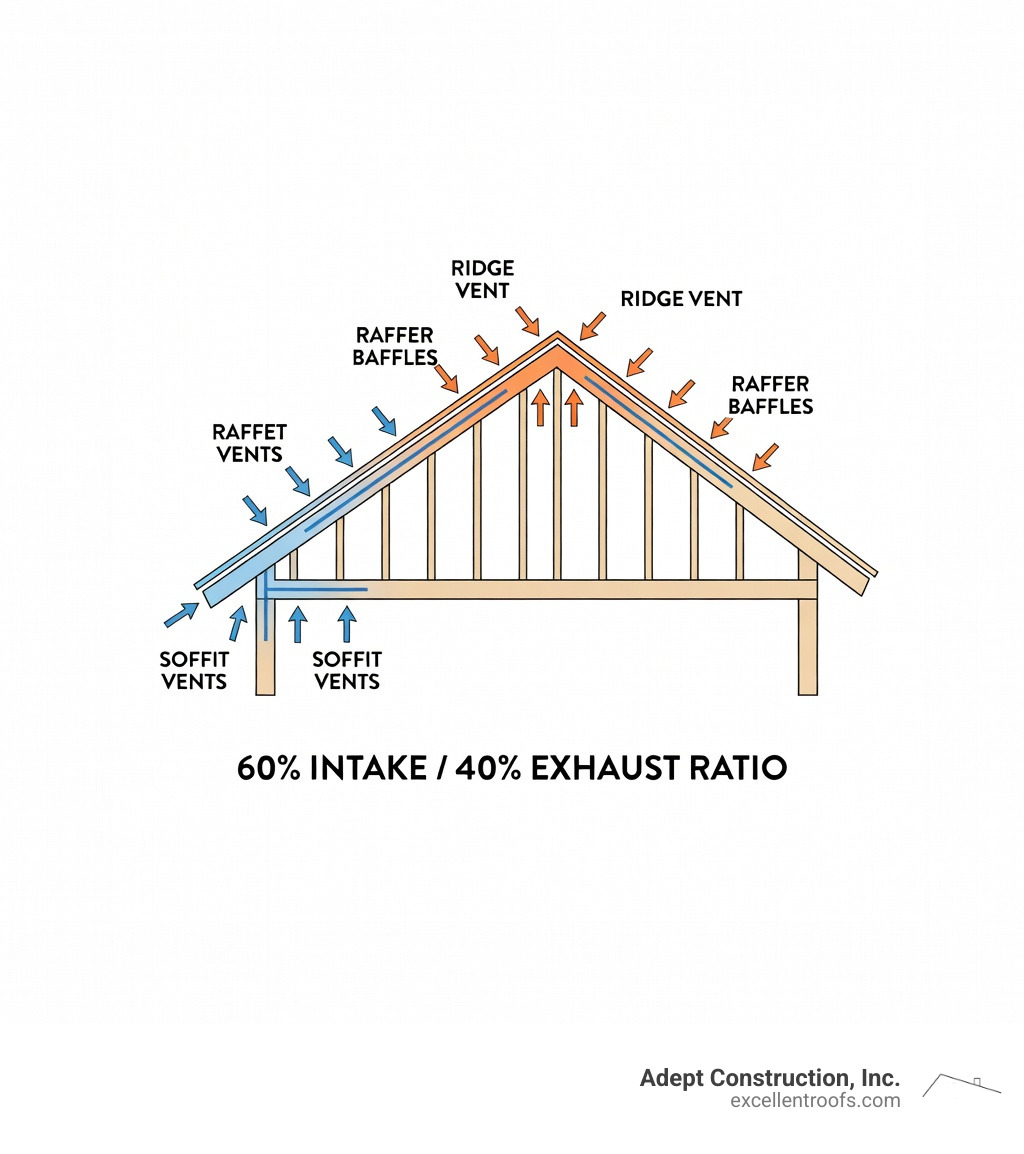
- Ideal balance: 60% intake (soffit vents) / 40% exhaust (ridge vents)
- Key warning signs of poor ventilation: Ice dams, mold, high energy bills, warped sheathing
- Best passive system: Soffit vents + rafter baffles + ridge vents working together
Most homeowners focus on shingles, color, and cost when thinking about their roof. Ventilation rarely comes up — until something goes wrong. But the reality is that a poorly ventilated attic quietly causes damage every single day, from rotting roof decking to skyrocketing cooling bills to shingles that fail years ahead of schedule.
Think of your attic like a living space that needs fresh air. Without it, heat and moisture build up and have nowhere to go. That trapped air becomes your roof’s worst enemy — warping wood, feeding mold, and in winter, creating dangerous ice dams along your eaves.
The good news: proper ventilation isn’t complicated once you understand how it works. And getting it right is one of the best investments you can make in your home’s long-term roofing performance.
I’m Gerald Michaels, founder of Adept Construction, Inc., and over nearly three decades of installing and inspecting residential roof ventilation systems across Naperville and the Chicago suburbs, I’ve seen how often ventilation problems are the root cause of expensive roof failures. In this guide, I’ll walk you through everything you need to know — from building code requirements to vent types to the mistakes that silently shorten your roof’s life.
Learn more about residential roof ventilation:
The Primary Purpose of Residential Roof Ventilation
The primary purpose of residential roof ventilation is to maintain a “balanced” environment within the attic space, ensuring that the temperature and humidity inside the attic closely mimic the conditions outside. While it might seem counterintuitive to let cold air into your home during a Naperville winter, this airflow is essential for the structural integrity of your residential roofing system.
In the summer, an unventilated attic can reach temperatures upward of 150°F. This extreme heat radiates downward into your living spaces, forcing your air conditioner to work overtime. More importantly, it “bakes” your shingles from the inside out, causing them to become brittle and age prematurely. Research shows that unvented shingles operate 2°F to 3°F warmer than vented assemblies, which can reduce their total service life by roughly 10%.
In the winter, the enemy is moisture. A typical family of four generates 2 to 4 gallons of water vapor every day through showering, cooking, and laundry. This warm, moist air rises into the attic. If it can’t escape, it condenses on the cold underside of the roof deck. This leads to:
- Mold and Mildew Growth: Fungi thrive in damp, dark attics, rotting the wood framing and potentially affecting indoor air quality.
- Ice Dams: Trapped heat melts snow on the upper parts of the roof. The water runs down to the cold eaves and refreezes, creating a dam that forces water back under the shingles and into your home.
- Wet Insulation: Condensation drips onto floor insulation, compressing the fibers and significantly reducing its R-value.
According to ENERGY STAR, a properly ventilated attic should never be more than 15 degrees warmer than the outside air. Achieving this requires a deep understanding of how air moves naturally.
Passive vs. Active Residential Roof Ventilation
When designing a ventilation strategy, we choose between passive and active systems.
Passive Ventilation relies on natural physics—specifically the “stack effect” and the “wind effect.” The stack effect occurs because hot air is less dense than cold air; it naturally rises and exits through high-point exhaust vents, pulling cooler air in through low-point intake vents. The wind effect occurs when wind blowing over the roof creates a pressure difference that “pulls” air out of the vents. Passive systems are often considered “green” because they require zero electricity and have no moving parts to fail.
Active Ventilation involves mechanical assistance, such as electric or solar-powered fans. These fans are designed to pull air out of the attic at a high rate. While they can be effective in specific scenarios, they must be used with caution. If an attic is not properly air-sealed from the house, a powerful fan can actually pull conditioned (cooled or heated) air from your living space into the attic, increasing your energy bills.
Impact of Climate on Residential Roof Ventilation
In the Illinois climate, our roofs face extreme seasonal swings. During our humid summers, ventilation is your primary defense against wood rot and shingle “toastiness.” In our freezing winters, it is the only way to prevent the devastating cycle of ice dams.
A well-designed system ensures that the roof deck stays cold enough in the winter so that snow doesn’t melt prematurely, yet stays dry enough that frost doesn’t build up on the rafters. For homeowners in Downers Grove and Naperville, this balance is the difference between a roof that lasts 30 years and one that needs a residential roof replacement after only 15.
Understanding Building Codes and Net Free Area (NFA)
Building codes exist to ensure your home remains safe and durable. For residential roof ventilation, the International Residential Code (IRC) Section R806 sets the standard. The most important concept to understand is Net Free Area (NFA). This refers to the actual unobstructed space through which air can pass. A vent might be 12 inches wide, but because of screens and louvers, its NFA might only be 50 square inches.
The standard code requirements are:
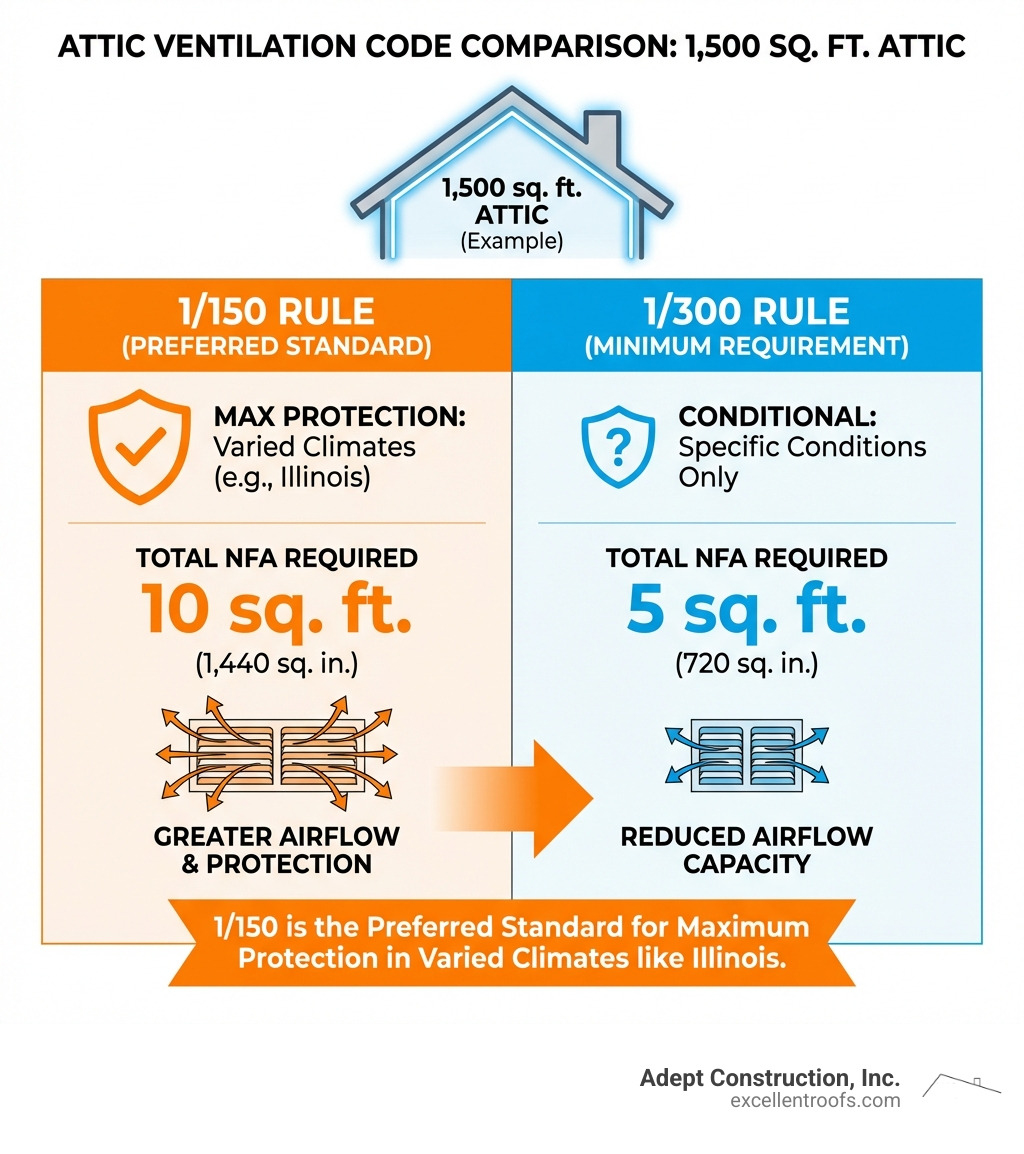
- The 1/150 Rule: This is the general minimum requirement. You must provide 1 square foot of NFA for every 150 square feet of vented attic floor space.
- The 1/300 Rule: You can reduce the ventilation requirement to 1 square foot per 300 square feet of attic space if two conditions are met:
- A vapor retarder is installed on the “warm-in-winter” side of the ceiling.
- Between 40% and 50% of the required ventilation is located in the upper portion of the roof (exhaust).
Adhering to these codes is a fundamental part of professional roof construction. It’s not just about passing an inspection; it’s about ensuring the manufacturer’s warranty on your shingles remains valid.
Calculating NFA for Your Home
Calculating your needs doesn’t require an advanced math degree. Here is a simple shortcut we use at Adept Construction, Inc. to determine the NFA for a standard 1/150 ratio:
- Measure the Attic Floor: Multiply the length of the attic floor by the width (e.g., 40 ft x 30 ft = 1,200 sq. ft.).
- Determine Total NFA Needed: Divide the square footage by 150 (1,200 / 150 = 8 sq. ft. of NFA).
- Convert to Square Inches: Multiply by 144 (8 x 144 = 1,152 total sq. in. of NFA).
- Split for Balance: Divide by 2 to find how much intake and exhaust you need (1,152 / 2 = 576 sq. in. of intake and 576 sq. in. of exhaust).
Once you have these numbers, you simply look at the NFA rating on the vents you plan to install. If a specific soffit vent provides 9 square inches of NFA, you would need 64 of them (576 / 9) to meet your intake requirement.
Comparing Types of Roof Vents and Systems
Not all vents are created equal. The “best” system depends on your roof’s architecture and pitch. We generally categorize vents into Intake (low) and Exhaust (high).
Intake Vents
- Soffit Vents: Installed under the eaves. These are the gold standard for intake. They can be individual “spot” vents or continuous strips.
- Drip Edge Vents: Used when a home has no eaves or soffits. These allow air to enter at the very edge of the roofline.
Exhaust Vents
- Ridge Vents: These run along the peak of the roof. They are highly efficient because they are at the highest point, facilitating the stack effect across the entire roof deck.
- Static Vents (Box Vents): These are individual hoods installed near the ridge. They are effective but often require several units to meet NFA requirements.
- Turbine Vents (Whirlybirds): These use wind to spin a fan that pulls air out. They are very effective in breezy areas but have moving parts that can eventually squeak or seize.
- Powered Attic Fans: Electric or solar-powered. These move a lot of air quickly but can be noisy and may pull air from the home if not carefully installed.
When we design roofing systems, we aim for a setup that provides uniform airflow across every rafter bay.
Ideal Balance in Residential Roof Ventilation
The most common mistake in residential roof ventilation is having plenty of exhaust but no intake. This creates a vacuum. If the air can’t come in through the soffits, it will be sucked up from your house through recessed lights and attic hatches.
The Asphalt Roofing Manufacturers Association (ARMA) and other industry experts recommend a balanced system, but many pros actually prefer a 60/40 split—where 60% of the NFA is intake and 40% is exhaust. Why? Because it’s better to have a slight over-supply of intake air. This “pressurizes” the attic, ensuring that air is always pushing out of the exhaust vents, which prevents rain or snow from being “sucked” into the ridge vent during high winds.
Installation Best Practices for Optimal Airflow
Proper installation is just as important as the math. Even the best vents won’t work if the path is blocked.
- Use Baffles (Rafter Vents): These are plastic or foam channels installed between the rafters where the roof meets the floor. They ensure that your attic insulation doesn’t block the air coming in from the soffit vents.
- Maintain a 2-Inch Airspace: For “skillion” or cathedral ceilings where the ceiling is the roof deck, you must maintain at least a 2-inch gap between the insulation and the wood sheathing to allow air to travel from the eave to the ridge.
- Place Exhaust High: Exhaust vents should be within 3 feet of the ridge to be effective.
- Seal the Attic Floor: Before worrying about vents, ensure the “envelope” of your home is sealed. This includes weather-stripping the attic access and using fire-rated caulk around plumbing stacks and wires.
If you are considering a new roof installation, ensure your contractor includes a detailed ventilation plan in the quote.
Troubleshooting Poor Residential Roof Ventilation
How do you know if your attic is struggling? Keep an eye out for these warning signs:
- Extreme Heat: If your second floor is significantly warmer than your first floor in the summer.
- Ice Dams and Icicles: Frequent icicles along the gutters are a classic sign of heat loss and poor venting.
- Moldy Smell: A musty odor when you open the attic hatch.
- Rusty Nails: If the tips of the nails poking through your roof deck are rusty, it means condensation is occurring.
- Warped Sheathing: “Wavy” looking shingles often indicate that the wood decking underneath has warped due to moisture.
Common Mistakes and Maintenance Requirements
In our years serving the Downers Grove community, we’ve seen several recurring errors that lead to roofing maintenance nightmares.
Mistake #1: Mixing Exhaust Types. Never install a ridge vent and a powered fan (or a gable vent) in the same attic space. The fan will “short circuit” the system, pulling air from the ridge vent instead of the soffit vents. This leaves the lower half of your roof deck unventilated.
Mistake #2: Blocking Soffits with Insulation. This is the #1 cause of ventilation failure. Homeowners or inexperienced insulators push fiberglass batts all the way to the edge, completely sealing off the intake air.
Mistake #3: Forgetting the Maintenance. Vents are not “set it and forget it.”
- Annual Inspection: Check your soffit vents to ensure they aren’t clogged with dust, spider webs, or bird nests.
- Debris Removal: Ensure leaves and branches aren’t blocking your ridge vents or static boxes.
- Check Baffles: Ensure baffles haven’t shifted or collapsed under the weight of blown-in insulation.
Frequently Asked Questions about Attic Airflow
How do I calculate the required ventilation for my attic?
Measure your attic floor square footage and divide by 150. This gives you the total square feet of Net Free Area (NFA) needed. Convert that to square inches (multiply by 144) and aim to split that 50/50 (or 60/40) between your intake (soffits) and exhaust (ridge).
Can a roof have too much ventilation?
In a passive system, it is very difficult to “over-ventilate” as long as the system is balanced. However, if you have massive amounts of exhaust without matching intake, you can create pressure problems that pull air from your home or pull rain/snow into the vents.
When is an unvented roof assembly appropriate?
Unvented roofs (conditioned attics) are appropriate for complex roof designs where traditional venting is impossible, or when you want to put HVAC equipment in the attic. These require specific spray foam insulation applied directly to the underside of the roof deck and must meet strict local building codes to prevent moisture traps.
Conclusion
Your roof is more than just shingles—it’s a high-performance system designed to protect your home. Without proper residential roof ventilation, even the most expensive shingles will fail prematurely. By ensuring a balanced flow of air, you protect your home from mold, lower your energy bills, and prevent the winter headache of ice dams.
At Adept Construction, Inc., we’ve built our reputation in Downers Grove and Naperville on doing the job right the first time. Whether you need a simple roof repair in Downers Grove or a complete roof replacement in Naperville, our team is here to ensure your attic can breathe easy.
Don’t wait for a leak or a mold bloom to find out your ventilation isn’t working. We offer free, honest estimates and comprehensive attic inspections.
Contact Adept Construction, Inc. today for your free estimate and let us help you protect your investment!
Learn more about our residential roofing services and how we can help you maintain a healthy home.