

Navigating the storm damage claim process: A Step-by-Step Guide
The storm damage claim process is a series of steps homeowners take to report property damage, document losses, and recover repair costs through their insurance policy. For those requiring expert roofing services in Downers Grove, navigating this process correctly is the key to a full recovery. Here is a quick overview of how it works:
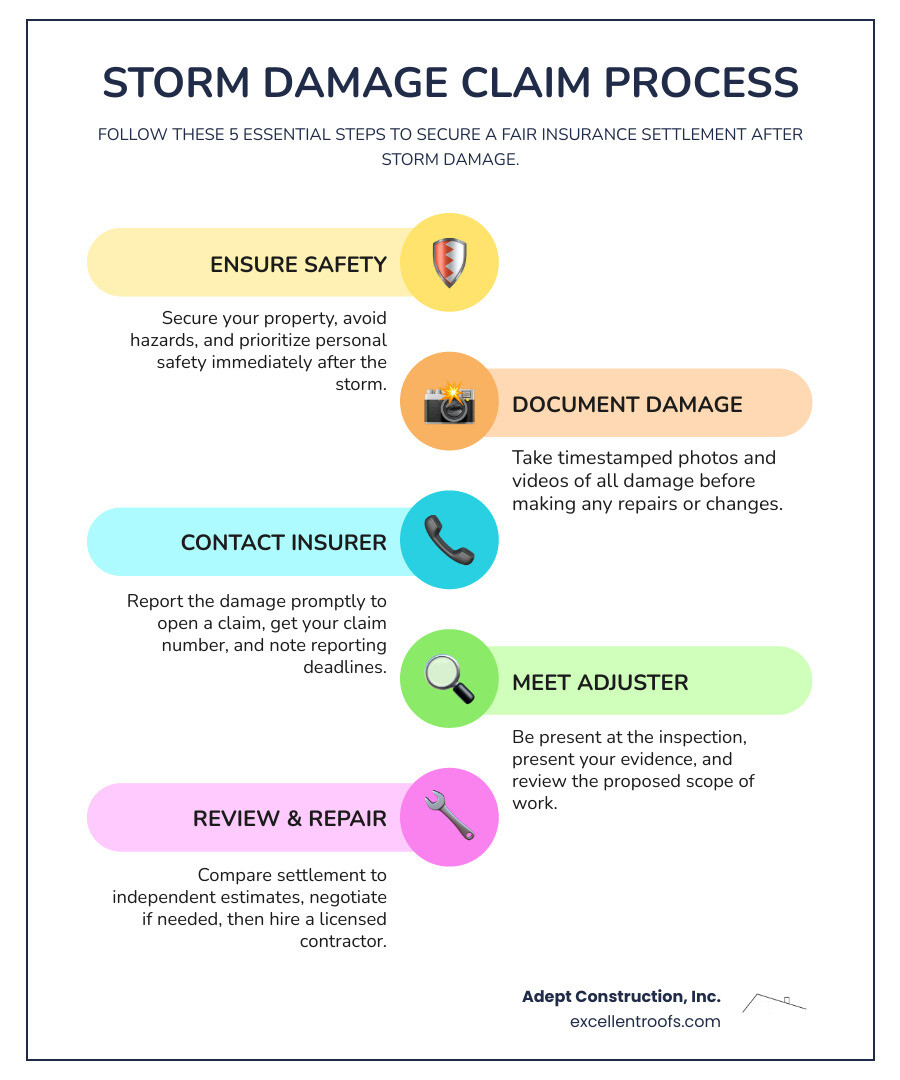
- Ensure safety – Secure your home and avoid hazards immediately after the storm.
- Document all damage – Take timestamped photos and videos before touching anything.
- Contact your insurer – Report the damage promptly to open a claim and get a claim number.
- Meet with the adjuster – Be present during the inspection and present your evidence.
- Review the settlement – Compare the offer to independent contractor estimates and negotiate if needed.
- Complete repairs – Hire a licensed local contractor and submit final documentation to close the claim.
Storms can strike fast — and the damage they leave behind is expensive. Roof repair and replacement costs across the U.S. soared to nearly $31 billion in 2024, a 30% increase since 2022, driven almost entirely by wind and hail events. Wind and hail alone accounted for more than half of all residential roofing claims that year.
Yet despite how common these claims are, the process is far from simple. Insurance policies are full of fine print. Adjusters work for the insurer, not for you. And in 2024, 14 of the largest U.S. insurance companies closed between 40% and 51% of homeowner claims with no payment at all.
Knowing exactly what to do — and when — makes a real difference in whether you get a fair settlement or walk away shortchanged.
This guide walks you through every stage of the storm damage claim process, from the minutes after a storm hits to the final repair sign-off.
I’m Gerald Michaels, founder of Adept Construction, Inc., a family-owned roofing company based in Naperville, Illinois, with nearly three decades of experience helping homeowners navigate storm damage repairs and the insurance claim process. Over that time, I’ve seen what separates a smooth, fully-paid claim from a frustrating denial — and this guide is built on those lessons.
At Adept Construction, Inc., we believe that a trusted local roofing expert is your best ally when Mother Nature decides to remodel your home without permission. Whether you are in Naperville or Downers Grove, understanding your rights and the necessary steps is the first step toward a full recovery.
When the clouds clear and the winds die down, your first instinct might be to grab a ladder and start fixing things. Hold that thought! The storm damage claim process requires a very specific order of operations to ensure you don’t accidentally invalidate your coverage.
First and foremost, ensure your family is safe. Avoid downed power lines, standing water, and unstable structures. Once the immediate danger has passed, your “policyholder duty” kicks in: you must mitigate further damage. This means taking “reasonable steps” to prevent the situation from getting worse. For example, if a tree limb smashed a hole in your roof, you should have it tarped to prevent rain from ruining your living room.
By following these storm damage insurance claim immediate steps, you can ensure a smoother path to recovery. We recommend calling a professional for a comprehensive storm damage assessment before you even pick up the phone to call your agent. Why? Because an expert roofer can spot the subtle signs of hail or wind uplift that an untrained eye (or a rushed adjuster) might miss.
Initiating the storm damage claim process with Your Insurer
Speed is your friend. Most insurance companies have a time requirement for reporting a claim—often within 48 to 72 hours for the initial notification, though you may have up to a year to file the formal paperwork. Contact your insurer via their claims hotline or online portal immediately to get a claim number.
When you call, have the following ready:
- Your policy number.
- The date and time the storm occurred.
- A brief description of the damage.
- Your current contact information.
If you are having trouble finding your insurer’s contact details, your state insurance department can help. In Illinois, the Department of Insurance provides resources to help homeowners find their carriers and understand local regulations.
Overcoming Hurdles in the storm damage claim process
The process isn’t always a walk in the park. Common challenges include documentation gaps, where the insurer claims there isn’t enough proof the storm caused the damage, or adjuster delays that leave your home exposed for weeks.
While specific laws like Texas Insurance Code § 542.056 set strict timelines for insurers to acknowledge and pay claims in other regions, Illinois homeowners also have protections against “bad faith” delays. If your insurer is dragging their feet, remind them of their duty to investigate promptly.
Negotiation is a standard part of the storm damage claim process. If the initial offer feels like a “lowball,” don’t panic. This is where your independent contractor’s estimate becomes your strongest leverage. We often work directly with adjusters to review the “scope of work,” ensuring every shingle, flashing, and vent is accounted for.
Understanding Your Policy: Coverage, Exclusions, and Deductibles

Before you dive deep into a claim, you need to know what you’re actually paying for. Your insurance policy is a legal contract, and the “Declarations Page” is your cheat sheet. It lists your coverage limits, your deductible, and the types of perils covered.
Most standard homeowners policies include “Dwelling Coverage,” which protects the structure of your home (like the roof and siding), and “Personal Property Coverage” for the stuff inside. However, your homeowners insurance deductible is the amount you pay out of pocket before the insurance company kicks in.
For example, if you have a $1,000 deductible and the storm causes $8,000 in damage, the insurer pays $7,000. Be aware that some policies in storm-prone areas have “percentage deductibles” for wind and hail. If your home is insured for $300,000 and you have a 2% wind deductible, you’re on the hook for the first $6,000!
Covered Perils vs. Common Exclusions
Standard policies generally cover:
- Wind: Tornados, straight-line winds, and gusts that rip off shingles.
- Hail: Impact damage that bruises shingles or dents metal vents.
- Lightning: Fire or power surges caused by a strike.
- Fallen Trees: If a tree falls on your roof due to wind, it’s usually covered.
However, there are big exclusions. The most famous is flooding. Damage from rising groundwater or overflowing rivers is never covered by standard home insurance; you need separate flood insurance for that. Other exclusions include “wear and tear” (if your roof was already 30 years old and falling apart) and maintenance neglect. If your roof leaked because you didn’t clean your gutters for five years, the insurer might deny the claim.
Replacement Cost vs. Actual Cash Value
This is the single most important distinction in your policy. It determines how much money actually lands in your bank account.
| Feature | Replacement Cost (RC) | Actual Cash Value (ACV) |
|---|---|---|
| Calculation | Cost to buy new materials today | Cost to buy new minus depreciation |
| Payout | Higher; covers full repair/replacement | Lower; based on age and condition |
| Out-of-pocket | Just your deductible | Deductible + the “lost” value (depreciation) |
Knowing the RC vs ACV settlement differences is crucial. Most modern policies are RC, but they often pay out the ACV amount first. Once the repairs are completed by a professional, the insurer releases the “recoverable depreciation” to cover the full bill.
Documenting Damage and Working with Insurance Adjusters
Documentation is the “evidence” phase of the storm damage claim process. If you don’t document it, it didn’t happen. Start by creating a home inventory checklist of any damaged personal items.
For your roof, take timestamped photos and videos from the ground. Look for shingles in the yard or visible dents in your siding. However, do not climb onto a damaged roof yourself—it’s dangerous and you might cause more damage. Instead, rely on professional roof damage insurance claims documentation provided by a contractor. Following NAIC documentation tips like saving news reports of the storm can also help prove the “date of loss.”
Preparing for the Adjuster Inspection
The insurance adjuster’s job is to investigate the legitimacy of your claim and determine the “cost of repair.” They are often handling dozens of claims a week. To make their job easier (and ensure they don’t miss anything), we highly recommend being present during the inspection.
Even better? Have your roofing contractor there too. When we meet an adjuster on-site, we can point out specific details about the adjuster’s investigation that might be overlooked. We speak the same technical language as the adjuster, which helps in reaching an agreement on the “scope of work” right there on the roof.
Identifying Subtle Storm Damage
Not all storm damage is as obvious as a fallen tree. Hail, for instance, can be incredibly sneaky. It might just look like a small dark spot on a shingle, but that “bruise” signifies that the protective granules have been knocked away. Over time, the sun’s UV rays will bake that exposed asphalt, leading to leaks.
Common subtle signs include:
- Granule loss: Finding what looks like “sand” in your gutters.
- Dented metal: Check your gutters, downspouts, and roof vents for small dings.
- Hairline cracks: Subtle fractures in shingle mats.
If you suspect your roof took a hit, check out our hail damage roof repair guide to learn what to look for before the leaks start.
Handling Disputes, Denials, and Low Settlement Offers
It is a staggering fact that 40% and 51% of homeowner claims were closed with no payment by some of the largest insurers in 2024. If your claim is denied or the offer is too low, you have options.
First, stay calm. Ask for the denial in writing and look for the specific policy language they are citing. You can request a “re-inspection” with a different adjuster or file a formal appeal. Sometimes, providing a more detailed estimate from a licensed roofing professional is all it takes to turn a “no” into a “yes.”
When to Hire a Public Adjuster or Attorney
If you find yourself in a complex dispute or suspect “bad faith” (where the insurer is intentionally being unfair), you might need professional backup.
- Public Adjusters: These are independent professionals you hire to represent you, not the insurance company. They typically charge 5-15% of the final settlement but often secure payouts 30-40% higher than homeowners get on their own.
- Attorneys: If the claim involves massive losses or legal violations, a lawyer for insurance claims can file a lawsuit.
Always verify anyone you hire through the National Insurance Crime Bureau to avoid “storm chasers” and fraudsters who prey on disaster victims.
Filing a Complaint with the State
If negotiation fails, you can go to the regulators. Every state has an insurance division that handles consumer complaints. In Illinois, you would contact the Illinois Department of Insurance. Filing a complaint is a powerful way to get an insurer to take your dispute seriously, as it goes on their permanent regulatory record.
Choosing a Local Contractor for Storm Damage Roof Repair
After the storm damage claim process is settled, the real work begins. This is the most dangerous time for homeowners because “storm chasers” move into town. These are out-of-state companies that follow storms, knock on doors, and promise “free roofs.” They often do sub-par work and disappear before you realize your new roof is leaking.
Always choose a local, established company. Whether you need roof repair in Downers Grove, IL or roof repair in Naperville, IL, look for a contractor with a physical office and a long-standing reputation in the community.
Verifying Credentials and Workmanship
Don’t just take a contractor’s word for it. Verify their:
- IL Roofing License: In Illinois, roofing contractors must be licensed by the state.
- BBB Accreditation: Check for an A+ rating and read the reviews.
- Manufacturer Certifications: Companies that use Owens Corning shingles and carry their certifications can offer better warranties.
- Insurance: Ensure they have both liability and workers’ compensation insurance to protect you from lawsuits if an accident happens on your property.
The Role of the Restoration Specialist
A true restoration specialist does more than just nail down shingles. We act as your advocate. We ensure that the repairs meet current local building codes, which insurance is often required to pay for under “Law and Ordinance” coverage. From the initial storm damage assessment to the final shingle, we make sure your home is restored to its pre-storm condition—or better.
Frequently Asked Questions about Storm Damage Claims
How long do I have to report storm damage to my insurance company?
While many policies allow up to a year to file a formal claim, most require you to report the damage “promptly”—usually within 48 to 72 hours of discovering it. Waiting too long can lead to a denial based on “neglect” or “additional damage” that occurred because the initial issue wasn’t fixed.
Will filing a storm damage claim raise my insurance premiums?
Generally, no. Most states prohibit insurance companies from raising your individual rates for a single “Act of God” claim like a storm. However, if your entire neighborhood was hit by a massive hailstorm, the insurer may raise rates for the entire zip code to account for the increased risk.
Can I make temporary repairs before the insurance adjuster arrives?
Yes! In fact, your policy requires it. You should do whatever is necessary to prevent further damage, such as tarping a hole or boarding a window. Just make sure to take photos of the damage before you cover it up, and keep all receipts for materials or labor. These costs are typically reimbursable as part of your claim.
Conclusion
The storm damage claim process is a marathon, not a sprint. It requires patience, meticulous documentation, and a bit of “insurance-speak.” But you don’t have to do it alone.
At Adept Construction, Inc., we are more than just a roofing company. We are your neighbors in Naperville and Downers Grove. As a family-owned business, we pride ourselves on superior customer service, knowledgeable staff, and high-quality workmanship that stands up to the toughest Illinois weather. We’ve built our reputation on local referrals and the trust of homeowners just like you.
If a storm has left you feeling overwhelmed, let us take the lead. We offer professional inspections and will work with you every step of the way to ensure your roof is repaired correctly and your claim is handled fairly.
Don’t wait for the leaks to start. Contact us for a free storm damage estimate today and let us help you get your home back to normal.