
Is Your Old Roof Telling You Something? Here’s How to Know It’s Time
Old roof replacement is one of the most important — and most expensive — home decisions you’ll face. So it helps to know the signs before a small problem becomes a $30,000 structural nightmare.
Quick answer: Key signs your old roof needs replacing
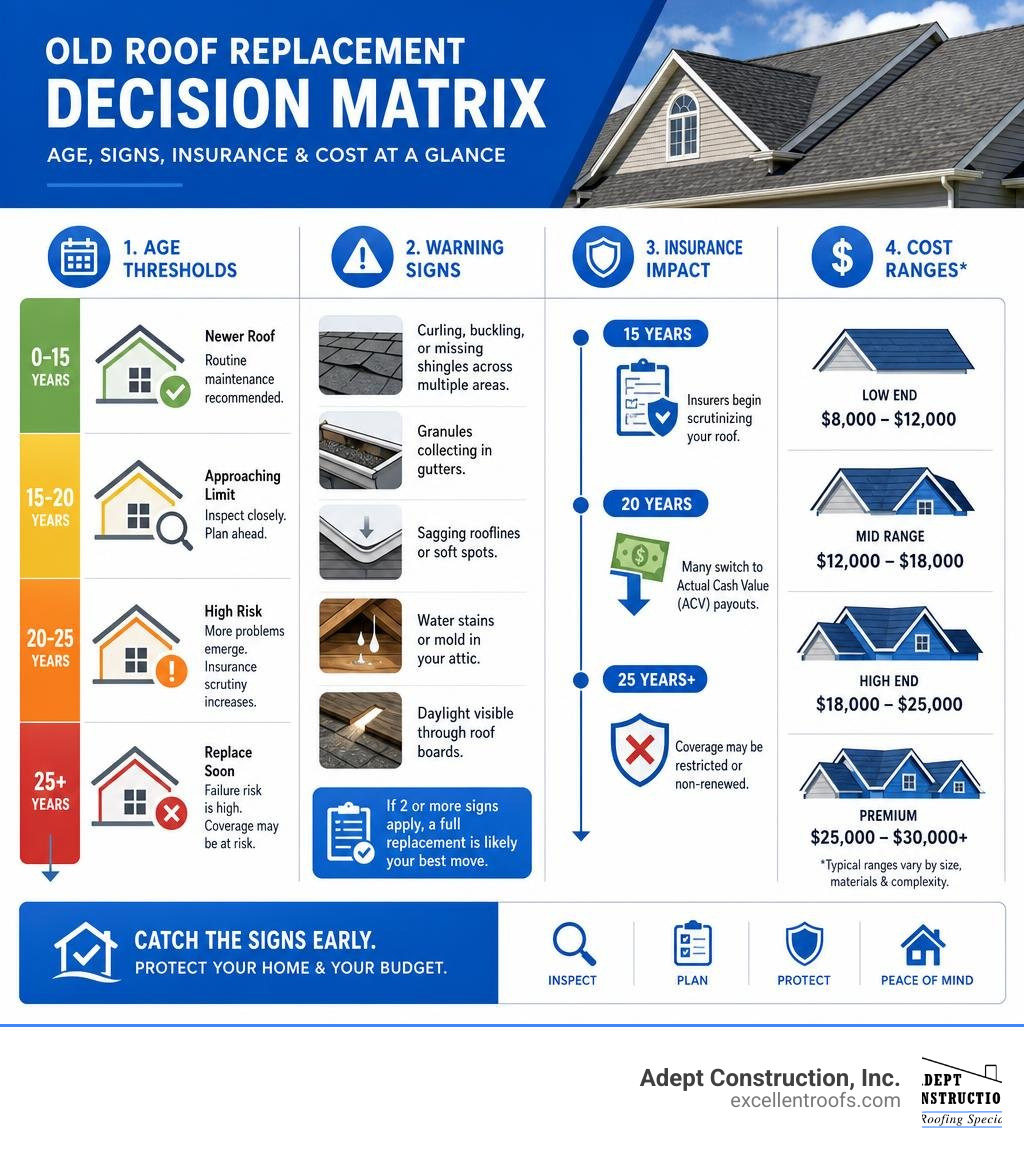
- Age: Asphalt shingle roofs last 20–30 years. If yours is past 20, it deserves a close look.
- Curling, buckling, or missing shingles across multiple areas — not just one spot.
- Granules collecting in your gutters — a sign shingles are breaking down.
- Sagging rooflines or soft spots — indicates compromised decking underneath.
- Water stains or mold in your attic — active leaks causing hidden damage.
- Daylight visible through roof boards — a clear structural red flag.
- Insurance pressure: Most insurers scrutinize roofs at 15 years, switch to actual cash value (ACV) payouts at 20 years, and may decline to renew coverage after 25 years.
If two or more of these apply to your roof, a full replacement is likely your most cost-effective path forward. Adept Construction offers free estimates — so you can get a straight answer without any commitment.
Your roof does more than keep rain out. It protects your home’s structure, insulation, and interior from the elements — and in the Chicago suburbs, that means surviving brutal freeze-thaw cycles, ice dams, hail, and high winds every single year. Most homeowners don’t think about their roof until something goes wrong. By then, what could have been a straightforward replacement has often turned into a much larger repair bill.
The reality is that an aging roof rarely fails all at once. It sends warning signs for months — sometimes years — before a leak appears on your ceiling. Knowing what to look for puts you in control of the timing and the cost.
I’m Gerald Michaels, founder of Adept Construction, Inc., and I’ve spent nearly three decades replacing old roofs across Naperville, Downers Grove, and the western Chicago suburbs. In that time, I’ve seen what happens when homeowners wait too long — and how much smoother things go when they catch the signs early and make an informed decision about old roof replacement before the damage compounds.
Simple old roof replacement word guide:
Crucial Indicators That It Is Time for an Old Roof Replacement
Determining whether your roof is past its prime requires a mix of ground-level observation, attic exploration, and professional evaluation. When we inspect homes in Downers Grove and Naperville, we look for physical and structural clues that tell us if the system is compromised.
If you suspect your roof is reaching the end of its functional life, starting with a comprehensive inspection is the smartest move. Understanding the process of replacing your home’s roof can help you spot the difference between cosmetic wear and a failing system.

Physical Warning Signs of Shingle Decay
Asphalt shingles degrade over time due to UV exposure, wind, and temperature swings. Here are the clear physical signs of decay:
- Curling and Buckling: When shingles curl (either the edges turn up or the middle bubbles up), they are no longer flat against the roof deck. This leaves your home highly vulnerable to wind uplift and water infiltration.
- Missing Shingles: A storm might blow off a shingle or two, which is easily repaired. But if shingles are repeatedly shedding across different slopes, the adhesive strips have failed permanently.
- Granule Loss: Shingle granules protect the underlying asphalt from solar damage. If you notice bald spots on your shingles or see dark, coarse sand piling up in your gutters, your shingles have lost their protective layer and will rapidly deteriorate.
When shingles lose their structural integrity, the damage quickly migrates deeper into the roofing system, which is why look at the entire assembly beyond the shingles to ensure the home remains dry.
Structural Sagging and Active Attic Leaks
Physical shingle wear is bad, but structural failure is worse. If you notice any of the following, your roof requires immediate attention:
- A Sagging Roofline: A roof should have a straight, level ridge and flat planes. If you notice dips, curves, or sagging sections, it is a sign of compromised decking (sheathing) or weakened rafters underneath. This is often caused by long-term, slow moisture leaks rotting the wood foundation.
- Active Attic Leaks and Water Stains: Grab a flashlight and head into your attic during or immediately after a heavy rainstorm. Look for damp rafters, wet insulation, mold growth, or dark water stains on the wood boards.
- Daylight Through the Roof Boards: If you turn off your attic lights during the day and see pinpricks of sunlight shining through the roof boards, water can easily follow that same path.
Roof Repair vs. Full Replacement: Making the Cost-Effective Choice
As a rule of thumb, most homeowners spend between $400 and $2,000 on localized roof repairs, with a national average of just under $1,200. While a repair is cheaper upfront, it can be a waste of money if your roof is structurally failing.
To make the right choice, we recommend using the 30% Rule: If more than 25% to 30% of your roof is damaged, or if the cost of repairs exceeds 30% of a complete replacement, investing in a new roof is the more financially sound long-term decision. For a deeper look at budgeting for these scenarios, consult our ultimate guide to roof repair costs.
When to Choose Repair Over Old Roof Replacement
Repairing your roof is highly practical under the following conditions:
- The roof is young: If your architectural shingle roof is only 10 or 12 years old and has limited damage from a isolated fallen branch, a repair is the obvious choice.
- The damage is localized: If a small leak is isolated to a single plumbing boot, valley, or chimney flashing, we can typically replace the flashing and surrounding shingles without touching the rest of the roof.
- You need to buy time: If you are planning a complete old roof replacement in a year or two but need to stop an active leak right now, a temporary patch can protect your interior while you save or coordinate insurance.
If you are dealing with minor wind damage or a small leak in the western suburbs, scheduling a professional roof repair in Downers Grove can safely extend your roof’s lifespan without the immediate need for a full tear-off.
Average Lifespans of Common Roofing Materials
The material on your roof dictates how long it will last before replacement becomes inevitable. While asphalt is the most common choice, alternative materials offer vastly different lifespans.
| Roofing Material | Average Lifespan (Years) | Relative Upfront Cost | Notes |
|---|---|---|---|
| 3-Tab Asphalt Shingles | 15 – 20 | Low | Economical, but highly susceptible to wind and rapid wear. |
| Architectural Shingles | 25 – 30 | Moderate | Thicker, dimensional look; handles severe weather much better. |
| Metal Roofing | 40 – 70 | High | Extremely durable, fire-resistant, and sheds snow easily. |
| Clay / Concrete Tile | 50 – 100 | Very High | Heavy; requires strong structural framing; brittle if walked on. |
| Slate Roofing | 100 – 150+ | Extremely High | The ultimate “lifetime” roof; heavy and requires specialist installation. |
How Roof Age Impacts Your Homeowners Insurance Coverage
Many homeowners assume their insurance policy will pay for a brand-new roof whenever they decide it is too old. This is a costly misconception. Insurers do not cover normal wear and tear or neglect. They only pay for roof replacement if the damage was caused by a sudden, covered peril—such as a hail storm, fallen tree, or windstorm.
Furthermore, insurance companies have grown incredibly strict about roof age over the last few years. In 2026, many carriers automatically trigger a detailed review or demand a professional inspection once an asphalt roof reaches 15 years old.
Once your roof hits 20 years old, many carriers will refuse to renew your policy unless you replace the roof out-of-pocket, or they will dramatically alter your coverage terms.
Understanding RCV vs. ACV Policies for an Old Roof Replacement
How your policy is written determines how much money you will actually receive if your aging roof is damaged in a storm:
- Replacement Cost Value (RCV): This is the ideal coverage. If your roof is damaged by a covered storm, the insurance company will pay the full cost to replace it at current market rates (minus your deductible), regardless of how old the roof is.
- Actual Cash Value (ACV): Under an ACV policy, the insurer factor in depreciation based on the roof’s age. If a storm destroys a 20-year-old roof that would cost $15,000 to replace, and the shingles are near the end of their 20-year lifespan, the insurer might deduct 80% for depreciation. You would only receive a check for $3,000, leaving you to pay the remaining $12,000 out-of-pocket.
Many insurance carriers automatically switch roofs from RCV to ACV once they cross the 15-to-20-year threshold to limit their financial risk.
Steps to Maintain Insurance Coverage on an Aging Roof
To prevent your insurance company from dropping your coverage or denying a storm claim on an older roof, take these proactive steps:
- Schedule Regular Inspections: Have a licensed local roofing professional inspect your roof every few years and provide a written report showing it is still in sound condition.
- Keep Detailed Records: Save all receipts, contracts, and photos of any maintenance or minor repairs you perform. This proves you have not neglected the property.
- Trim Tree Branches: Cut back any branches hanging within six feet of your roofline to prevent scraping and damage during high winds.
- Keep Gutters and Valleys Clear: Remove leaves, twigs, and pine needles regularly so water can drain freely and prevent wood rot along your eaves.
If you are worried about how your aging roof stands up to local insurance requirements, our team in the Naperville, IL service area can provide a thorough inspection and honest assessment to help you maintain your coverage.
The Financials: Estimating Your Roof Replacement Costs
A full roof replacement is a major investment. Nationwide, a complete replacement can cost between $3,500 and $12,000 for every 1,000 square feet, depending on the complexity of the roof, the materials you select, and local labor rates.

Labor is a massive component of this investment, typically accounting for 60% of the total cost of a roof replacement. For example, on a standard $9,000 roof installation, approximately $5,400 goes toward labor, safety equipment, and overhead, while the remaining $3,600 covers materials. For a comprehensive overview of these numbers, read our residential roof replacement cost guide.
Cost Breakdown by Material and Home Size
To help you budget, here is a general breakdown of typical costs based on common home sizes and material choices in our region:
- Asphalt Shingles (Architectural): Typically ranges from $8,000 to $15,000 for a standard 1,500 to 2,000 square foot home. If you want to see a granular breakdown of these specific costs, check out our guide on 1500 sq ft shingle roof cost.
- Metal Roofing: Generally runs between $15,000 and $35,000+ depending on whether you choose exposed fastener utility panels or premium standing-seam metal panels.
- Slate or Tile: Usually starts at $30,000 and can easily exceed $60,000 for larger, historic properties.
For a deeper dive into the specific variables that influence these ranges—such as roof pitch, height, and decking condition—refer to our complete roof replacement cost guide.
Regional Cost Variations and Resale Value ROI
Roofing costs vary significantly by region. In the Chicago western suburbs, labor rates, local building permits, and disposal fees are higher than the national average. Additionally, local building codes require specific ice-and-water shield configurations because of our severe winter weather.
However, a new roof offers an excellent return on investment (ROI). According to remodeling cost vs. value data, a new roof can add over $17,000 to a home’s resale value, representing a 60% to 70% return on investment.
More importantly, an old, failing roof is a massive red flag for home buyers. Most buyers will either demand a massive price reduction or walk away entirely if the roof is past its prime. If you are preparing to sell, investing in a high-quality roof replacement in Naperville IL can protect your equity and streamline the closing process.
Tear-Off vs. Overlay: Choosing the Right Installation Method
When replacing an old asphalt roof, you have two primary options: a complete tear-off (removing all old materials down to the wood deck) or a roof overlay (nailing new shingles directly over the existing ones, also known as reroofing).
To understand the full scope of what a complete tear-off entails, read about the whole shebang of shingle replacement.
Pros and Cons of a Roof Overlay
An overlay is often tempting because it can cost up to 40% less upfront and can be completed in just one or two days. However, it comes with severe long-term drawbacks:
- Trapped Heat: Nailing a second layer of shingles traps heat between the layers, causing the top shingles to bake, curl prematurely, and fail much faster. An overlay typically lasts only 15 to 16 years compared to the 25 to 30 years you get from a clean installation.
- Voided Warranties: Many major shingle manufacturers will void or severely limit their product warranties if the shingles are installed over an existing layer.
- Hidden Deck Rot: You cannot inspect the wood decking beneath your old shingles during an overlay. If there is rot, mold, or structural sagging, it will remain hidden and continue to worsen.
- Excess Weight: A single layer of shingles on a 2,000 sq. ft. home weighs between 4,000 and 6,000 pounds. Adding a second layer adds massive structural stress to your rafters. Because of this, Illinois building codes restrict homes to a maximum of two roofing layers.
Organizations like the Asphalt Roofing Manufacturers Association guidelines strongly recommend a complete tear-off for optimal system performance and warranty compliance.
Why a Full Tear-Off is the Superior Long-Term Choice
While a full tear-off has a higher upfront cost, it is the only way to ensure your new roof lasts its full intended lifespan.
During a tear-off, we remove every single old shingle, nail, and underlayment layer. This allows us to perform a 100% inspection of the wood sheathing (decking) underneath. If we find any soft spots or rot, we replace those sheets to create a perfectly flat, solid foundation.
We then install modern synthetic underlayment and heavy-duty ice and water shields along the eaves and valleys to prevent winter ice dams from forcing water into your home. If you are planning your budget, learning about the shingle scoop budgeting can help you navigate these material choices.
Frequently Asked Questions About Old Roofs
How old is too old for a roof before insurance drops coverage?
Most insurance companies begin closely scrutinizing asphalt shingle roofs once they reach 15 years old. At 20 years old, many carriers will automatically switch your policy from Replacement Cost Value (RCV) to Actual Cash Value (ACV), meaning they will deduct heavy depreciation from any storm damage payout. Once a roof passes 25 years old, some insurance companies may refuse to renew your policy entirely until the roof is fully replaced.
Does a new roof increase a home’s resale value?
Yes. A new roof adds an average of over $17,000 to a home’s resale value, typically yielding a 60% to 70% return on investment. Beyond the direct financial ROI, a new roof dramatically increases buyer confidence, improves curb appeal, and prevents home sales from falling through during the home inspection phase.
Can I install a new roof over my existing shingles?
While local building codes in Downers Grove and Naperville allow a maximum of two shingle layers, installing an overlay is rarely recommended. It traps heat, voids manufacturer warranties, adds thousands of pounds of extra weight to your home’s structure, and prevents contractors from inspecting and repairing rot in the underlying wood deck. A full tear-off is always the safer, more durable option.
Conclusion
An old roof replacement is a significant undertaking, but it is one of the most critical steps you can take to preserve your home’s structural integrity, safety, and market value. Trying to squeeze a few extra years out of a failing roof often leads to costly interior water damage, mold remediation, and insurance headaches.
At Adept Construction, Inc., we believe in providing honest, transparent guidance to our neighbors in Downers Grove, Naperville, and the surrounding western suburbs. As a family-owned local business, we don’t believe in high-pressure sales tactics. We provide clear, accurate inspections, high-quality workmanship, and superior customer service.
If you are unsure whether your roof needs a simple repair or a complete replacement, let us take a look. We will give you a straight, honest answer so you can make the best decision for your family and your budget.
Contact Adept Construction, Inc. today to schedule your residential roofing services consultation and receive a free, no-obligation estimate!