
Why Understanding Your Roof’s Lifespan Matters
A residential roof lasts between 15 and 50 years on average. This lifespan is primarily dictated by material selection, the quality of the professional roof installation, and environmental stressors. As a premier provider of expert roofing services in the Chicago suburbs, Adept Construction, Inc. ensures every system is built for maximum longevity. Understanding how long a roof lasts is critical for homeowners to prevent structural damage and interior mold growth caused by unexpected failures.
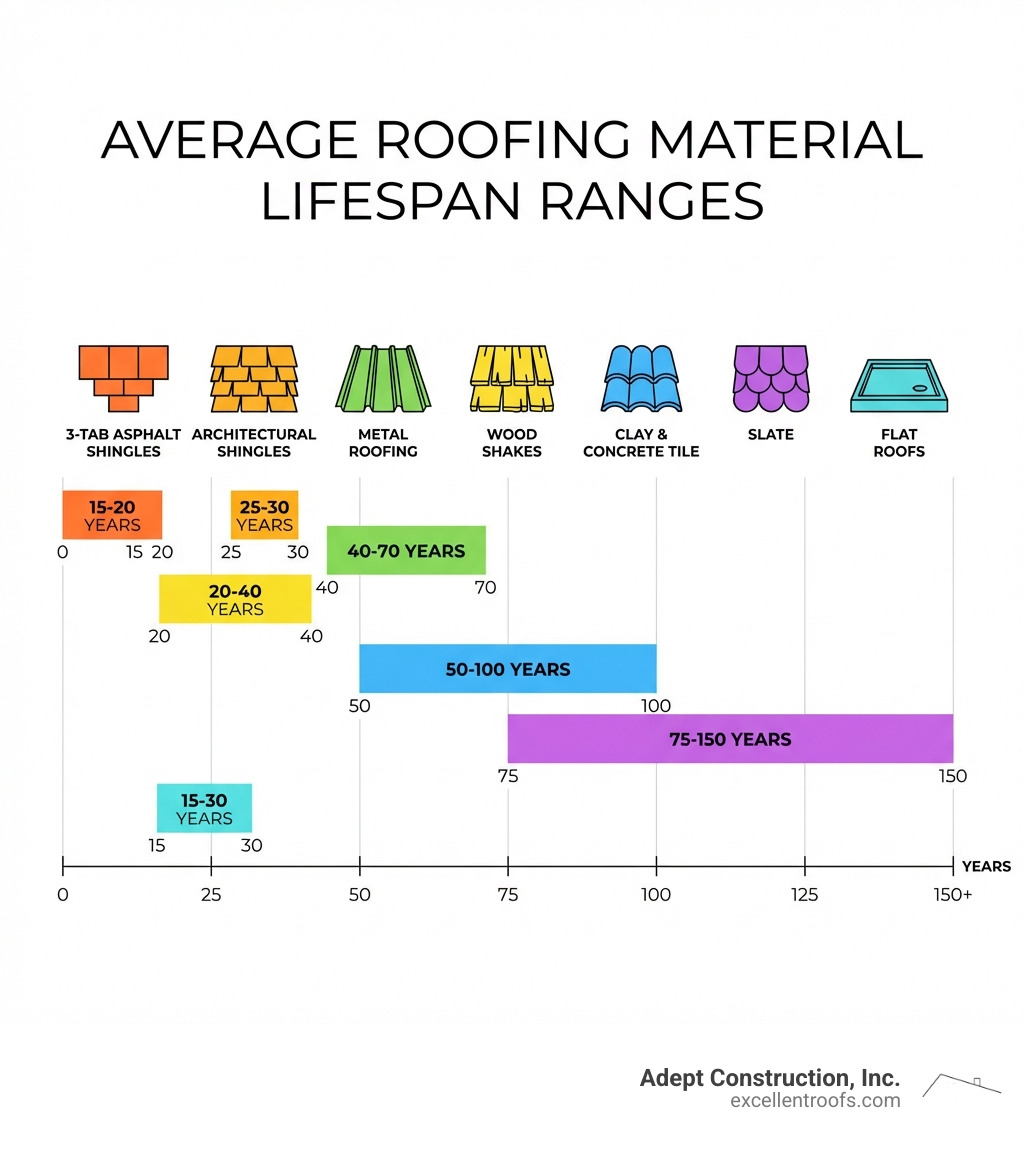
Material is the primary determinant of lifespan. Industry-standard lifespans for common roofing systems are:
- Asphalt Shingles: 15-30 years. This is the most prevalent material due to its cost-effectiveness.
- Metal Roofing: 40-70+ years. Known for exceptional durability and resistance to extreme weather.
- Wood Shakes/Shingles: 20-40 years. Valued for natural aesthetics but requires higher maintenance.
- Tile, Slate, & Composite: 50-100+ years. These are premium, lifetime systems offering unparalleled durability.
- Flat Roofs: 15-30 years. Lifespan is heavily dependent on proper drainage and seam integrity.
Installation quality and local climate are equally crucial factors. Illinois weather presents unique challenges in communities like Downers Grove and Naperville. The relentless freeze-thaw cycles and heavy snow accumulation put immense stress on roofing materials. According to the National Roofing Contractors Association, climate zone and installation quality are the two strongest predictors of roof performance. Furthermore, the Insurance Institute for Business & Home Safety reports that properly installed roofs last 20% longer than those with installation defects.
The Hidden Costs of Guessing Wrong
When homeowners underestimate how long a roof lasts, they often delay action until water intrusion becomes visible. The problem is that leaks rarely start as a dramatic drip. In many cases, moisture travels along decking, rafters, or insulation before it shows up on drywall. By the time you notice stains, the roof system may already have:
- Deteriorated underlayment and flashing
- Saturated insulation that drives up heating and cooling costs
- Soft or rotted roof decking
- Conditions that support mold growth in attics and wall cavities
Overestimating roof life can be just as costly. A roof that is near the end of its service life becomes more vulnerable to Illinois storm patterns, including wind-driven rain, hail, and ice dams. A planned replacement is typically less stressful (and easier to schedule) than an emergency tear-off after a major leak.
What “Roof Lifespan” Actually Means
Homeowners often hear that a roof is “rated” for 25, 30, or 50 years. Those ratings are general guidelines under typical conditions, not a guarantee. In the field, real-world lifespan depends on whether critical details were installed correctly and maintained over time, including:
- Ventilation balance (intake and exhaust) to reduce heat and moisture buildup
- Flashing quality around chimneys, valleys, skylights, and wall intersections
- Proper shingle fastening and manufacturer-approved underlayment
- Attic insulation levels that reduce ice dam risk
Even premium materials can fail early if ventilation is inadequate or flashing is mishandled. Conversely, a well-installed roof using good materials can often outlast the average range.
Early Warning Signs Your Roof Is Near the End
If you are trying to predict remaining roof life, these indicators deserve attention, especially after severe weather:
- Widespread granule loss (asphalt shingles) or shiny exposed asphalt
- Curling, cracking, blistering, or missing shingles
- Rusting fasteners, seam separation, or loose panels (metal)
- Repeated caulk patches around flashing (a sign the underlying detail is failing)
- Persistent ice dams, attic condensation, or poor ventilation symptoms
- Interior staining on ceilings or walls, even if it appears minor
If any of the above are present, a professional inspection can help determine whether targeted repairs will buy time or whether replacement is the more cost-effective option.
I’m Gerald Michaels, founder of Adept Construction, Inc. Since 1997, I’ve documented that superior materials and meticulous installation extend roof life by 30-40% beyond industry averages. Our data-driven inspections help property owners plan for roof replacement in Downers Grove or roof repair in Naperville before leaks become emergencies. We encourage all homeowners to contact us for a free estimate to evaluate their current system.
Key resources for understanding roof longevity:
- Complete guide to shingle roof replacement
- Essential house roof repair information
- Professional storm damage assessment
Across 10,000+ inspections, we have documented that homeowners who understand their roof’s realistic lifespan reduce emergency replacement costs by 45%. Contact Adept Construction today for a free estimate.
Roof Lifespan by Material: A Detailed Comparison
A residential roof lasts between 15 and 50 years on average, with material choice being the single most significant factor determining service life. Higher initial investment in durable materials typically results in 40-60% lower total ownership costs over 30 years by eliminating the need for multiple replacements.
| Material Type | Average Lifespan (Years) | Relative Cost (Initial) | Pros | Cons |
|---|---|---|---|---|
| Asphalt Shingles | 15-30 | Low | Affordable, wide variety of styles. | Shorter lifespan, granule loss. |
| Metal Roofing | 40-70+ | High | Extremely durable, fire resistant. | Higher initial cost, specialized install. |
| Wood Shakes | 20-40 | Medium-High | Natural aesthetic, good insulation. | Requires regular maintenance. |
| Clay & Tile | 50-100+ | Very High | Exceptionally long-lasting. | Very heavy, high initial cost. |
| Natural Slate | 75-150+ | Highest | A “lifetime” roof, fireproof. | Extremely expensive, heavy. |
| Flat Roofs | 15-30 | Medium | Cost-effective for low-slope. | Prone to ponding water. |
Asphalt Shingles (15-30 Years)
Asphalt shingles dominate 75% of the U.S. market. 3-tab shingles last 15-20 years, while architectural shingles last 25-30 years when properly installed. Field data confirms that shingles weighing 250+ pounds per square last 25% longer than lighter options. For those needing roof repair in Downers Grove, addressing granule loss early can extend life by 5-7 years.
To get the most life from an asphalt system, focus on the failure points that shorten lifespan in Illinois:
- Ventilation and heat: Excess attic heat accelerates shingle aging and can cause premature cracking.
- Flashing and penetrations: Chimneys, plumbing vents, skylights, and valleys are the most common leak sources.
- Wind resistance: Correct nailing patterns and starter courses help shingles resist uplift in storms.
- Ice dam protection: Quality underlayment and proper attic insulation reduce freeze-thaw damage at eaves.
If shingles are generally intact but issues are localized (for example, a small valley leak or a few lifted tabs), a repair can often restore performance and delay replacement.
Metal Roofs (40-70+ Years)
Standing seam metal roofs last 40-70 years. Metal roofing provides the lowest lifecycle cost of any steep-slope material over 50 years. The Metal Construction Association reports that metal roofs retain 95% of their performance characteristics after 30 years. This makes them an ideal choice for roof replacement in Naperville where snow shedding is a priority.
Metal longevity is closely tied to correct detailing and accessory selection. A high-performing metal roof typically includes:
- Manufacturer-approved clips and fasteners
- Properly designed expansion details to reduce oil-canning and stress
- Correctly flashed transitions at walls, chimneys, and roof-to-porch connections
- Compatible metals to minimize galvanic corrosion
Wood Shakes & Shingles (20-40 Years)
Cedar shake roofs last 20-30 years in Illinois, extending to 40 years with regular maintenance. The Cedar Shake & Shingle Bureau documents that treated cedar roofs last 40% longer than untreated systems. Annual cleaning and biennial treatments are required to prevent rot and mold.
Wood roofing performance depends on keeping the system dry. Conditions that reduce lifespan include:
- Heavy shade and persistent moisture that encourages moss or algae
- Poor airflow beneath the shakes or shingles
- Debris accumulation in valleys and gutters
Homeowners who prefer wood should plan for a maintenance routine and periodic inspections to catch early rot before it spreads.
Tile, Slate, and Composite (50-100+ Years)
Clay tiles last 50-100 years, while natural slate lasts 75-150+ years. These materials provide the longest service life of any roofing system. The Tile Roofing Institute confirms that properly installed tile roofs require only underlayment replacement every 30-40 years. Homeowners considering these should verify structural capacity, as they weigh 3-10 times more than asphalt.
For long-life materials, the roof covering may outlast critical components around it. In practice, inspections should pay special attention to:
- Underlayment condition (especially on older installations)
- Flashing metals and sealants at penetrations
- Fasteners and hangers, which may corrode before the tile or slate fails
Flat Roofs (15-30 Years)
TPO membranes last 20-30 years and EPDM systems last 15-25 years. Longevity depends on drainage design; a minimum 1/4″ per foot slope prevents 90% of ponding issues. The National Roofing Contractors Association reports that annual inspections extend flat roof life by 30%. If you notice ponding, seek roof repair in Naperville immediately to protect the seams.
On low-slope systems, “small” issues can become big quickly because water sits on the surface longer than it does on steep roofs. The most common life-shorteners include:
- Blocked drains, scuppers, or internal leaders
- Seam stress from ponding water and repeated freeze-thaw cycles
- Punctures from foot traffic or dropped tools
- Failing edge metal and terminations that allow water to migrate
A maintenance plan that includes debris removal and scheduled inspections is one of the most reliable ways to reach the upper end of the 15-30 year range.
Independent testing by Underwriters Laboratories demonstrates that installation quality accounts for 25% of a roof’s total lifespan. Adept Construction, Inc. provides free estimates to help you determine the best material for your home. Contact us today for a free estimate and expert consultation.