
What an Asphalt Shingles Cost Estimator Actually Tells You (2026 Pricing)
An asphalt shingles cost estimator gives you a fast, reliable way to budget a roof replacement before a single contractor sets foot on your property. Here is what most Illinois homeowners pay in 2026:
| Shingle Type | Installed Cost (per sq ft) | Total Cost — 2,000 sq ft Roof |
|---|---|---|
| 3-Tab Asphalt | $3.43 – $4.65 | $5,700 – $8,200 |
| Architectural | $4.50 – $7.00 | $9,000 – $14,500 |
| Premium Designer | $6.50 – $9.50 | $13,000 – $19,000+ |
Key facts before you call a contractor:
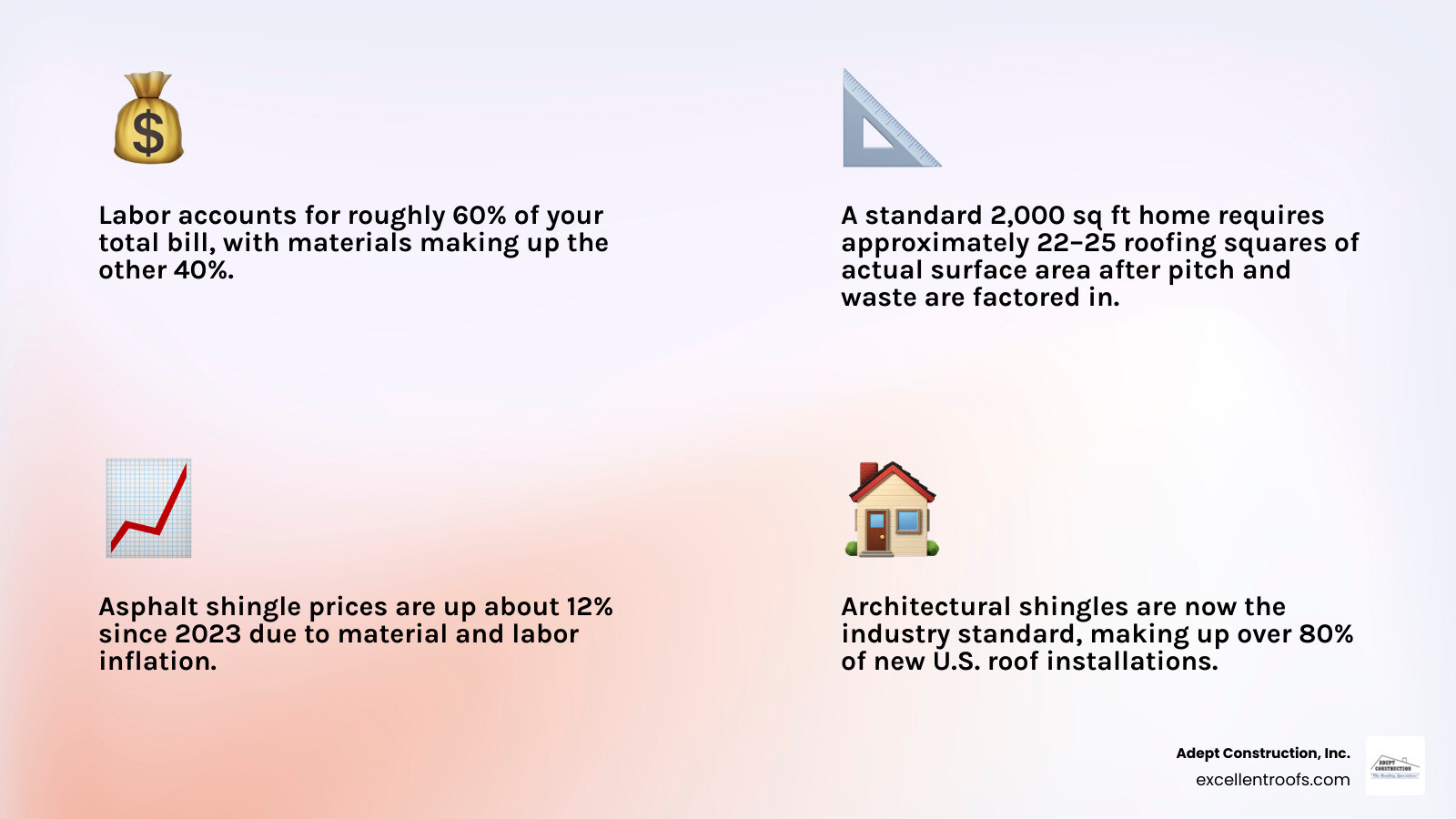
- Labor accounts for roughly 60% of your total bill — materials make up the other 40%.
- A standard 2,000 sq ft home requires approximately 22–25 roofing squares of actual surface area once pitch and waste are factored in.
- Asphalt shingle prices are up about 12% since 2023 due to material and labor inflation.
- Tear-off and disposal of one existing layer adds $100–$150 per square to your estimate.
- Architectural shingles are now the industry standard, making up over 80% of new U.S. roof installations.
Getting this number wrong by even a few dollars per square foot can mean a $3,000–$5,000 surprise. That is exactly why understanding how these estimates are built — line by line — matters so much before you sign anything.
If you want a roof replacement quote you can actually trust, Adept Construction offers free, no-obligation estimates for homeowners across the Chicago suburbs.
I’m Gerald Michaels, founder of Adept Construction, Inc., and I have spent nearly 30 years helping Naperville and Downers Grove homeowners navigate the real numbers behind an asphalt shingles cost estimator — not the padded bids or lowball traps. In this guide, I’ll walk you through every cost driver so you can evaluate any quote with confidence.
Relevant articles related to asphalt shingles cost estimator:
How to Use an Asphalt Shingles Cost Estimator for Your Home
To get an accurate estimate, you must calculate your actual roof surface area rather than relying on your home’s ground footprint. A building’s footprint is simply the flat overhead square footage of the structure’s foundation. Because roofs slope upward, their physical surface area is always significantly larger than the flat ground footprint of the house.
Professional estimators use the Unit Cost Method to calculate bids. This approach breaks down a project into individual units of measurement (usually “squares,” which equal 100 square feet) and applies localized material, labor, and disposal rates to each unit. This ensures transparency and builds mutual trust between homeowners and contractors.
To run these numbers yourself, you can use an online Asphalt Shingle Cost Calculator to establish a baseline. However, to understand the mathematical formulas behind the software, you must follow a two-step calculation process.
Step 1: Calculating Roof Surface Area with an Asphalt Shingles Cost Estimator
The actual roof surface area of a home is calculated by taking the ground footprint, adding the overhang of the eaves, and multiplying that sum by a specific pitch factor.
For example, a standard 1,500 square foot single-story ranch home in Downers Grove does not have 1,500 square feet of roof. When you factor in the eave overhangs (which typically stick out 1 to 2 feet around the perimeter), the flat footprint of the roof deck expands to roughly 1,700 square feet.
In the roofing industry, materials and labor are measured in “squares.” One roofing square is equal to exactly 100 square feet of roof surface. Therefore, a 1,700 square foot flat plane translates to 17 squares. To see how these base dimensions scale into final project costs, you can read our detailed breakdown on the 1,500 sq ft shingle roof cost.
Step 2: Adjusting for Pitch and Waste in Your Asphalt Shingles Cost Estimator
To convert your flat footprint area into the true sloped surface area, you must multiply the flat square footage by a slope correction factor (also known as a pitch multiplier).
Roof pitch is measured by how many inches the roof rises vertically for every 12 inches it runs horizontally. A standard walkable roof with a 6/12 pitch has a multiplier of 1.12. A steep, non-walkable roof with a 12/12 pitch has a multiplier of 1.414.
After adjusting for slope, you must add a waste factor of 10% to 15% to account for shingles that will be cut, overlapped, or used as ridge caps.
Let us look at the math for a 2,000 square foot flat footprint with a moderate 6/12 pitch:
- Calculate Sloped Area: 2,000 sq ft × 1.12 (pitch multiplier) = 2,240 sq ft of actual surface.
- Add Waste Factor: 2,240 sq ft × 1.10 (10% waste) = 2,464 sq ft.
- Convert to Squares: 2,464 divided by 100 = 24.6 squares (rounded up to 25 squares).
To calculate your own slope adjustments, you can use the interactive Roofing Cost Calculator – Material, Labor & Lifespan – AllTools to quickly toggle between different pitch multipliers.
Comparing Asphalt Shingle Types: Costs, Lifespan, and Performance
The grade of shingle you choose is the single largest variable affecting your material costs. Asphalt shingles are categorized into three primary tiers: 3-tab, architectural, and premium designer.
| Shingle Class | Material Cost (per square) | Average Lifespan | Wind Resistance | Warranty Period |
|---|---|---|---|---|
| 3-Tab | $90 – $120 | 15 – 20 Years | 60 mph | 20 to 25 Years |
| Architectural | $120 – $180 | 25 – 30 Years | 110 – 130 mph | 30-Year to Lifetime |
| Premium Designer | $180 – $350 | 30 – 50 Years | 130 mph+ | 50-Year to Lifetime |
To see how these material prices fluctuate by manufacturer and region, check out our comprehensive asphalt shingles prices guide 2026.
3-Tab Shingles: The Budget-Friendly Entry Option
Standard 3-tab shingles are the most affordable option, costing between $3.43 and $4.65 per square foot installed. They are manufactured as a single flat layer of fiberglass mat coated with asphalt and mineral granules, cut into three uniform tabs.
While they offer the lowest upfront price, they only last 15 to 20 years and are highly vulnerable to wind damage. If you are planning a budget-conscious replacement, you can read our guide on how to replace your 3-tab shingle roof to see if this option matches your long-term goals.
Architectural Shingles: The Modern Industry Standard
Architectural shingles (also called dimensional or laminate shingles) cost between $4.50 and $7.00 per square foot installed. They are constructed from two or more layers of asphalt-coated fiberglass laminated together, creating a dimensional, textured appearance that mimics natural wood shake.
Architectural shingles feature a 30-year warranty and are rated for winds up to 130 mph. They represent the best balance of cost and performance, making up over 80% of our installations in Downers Grove and Naperville. To analyze the exact cost difference, see our article on the cost to replace roof architectural shingles.
Premium Designer Shingles: Maximum Lifespan and Aesthetics
Premium designer shingles cost between $6.50 and $9.50 per square foot installed. These luxury shingles are thicker, heavier, and crafted to replicate the look of natural slate or old-world cedar shakes.
They can last up to 50 years and offer superior impact resistance (often Class 4 rated). In northern climates like Illinois, upgrading to a premium, impact-resistant shingle can sometimes qualify you for a 5% to 28% discount on your homeowners insurance premium.
Cost Breakdown: Materials, Labor, and Tear-Off Fees
A professional roofing estimate is never just a single lump sum. It is a combination of materials, labor, and preparation fees. On average, a standard roof replacement is split into a 60/40 ratio, where labor represents 60% of the total cost and materials make up the remaining 40%.
When budgeting for a complete system, we highly recommend choosing matched components from a single manufacturer to ensure you receive a comprehensive system warranty. You can explore these cohesive components on our page dedicated to asphalt shingle roofing systems.
Material Costs and Essential Roofing Accessories
Shingles alone do not make a roof. A code-compliant system requires several supportive materials:
- Underlayment: Synthetic underlayment has replaced traditional organic felt as the industry standard. It costs $1.50 to $2.10 per square foot and provides a tear-resistant, water-resistant barrier over your wood decking.
- Ice and Water Shield: This self-adhering membrane costs $1.87 to $2.53 per square foot. In northern Illinois, building codes require this membrane to extend from the eave edges to a point at least 24 inches inside the interior warm wall line to protect against ice damming.
- Drip Edge: Aluminum flashing installed along the eaves and rakes to direct water away from the fascia boards.
- Starter Shingles: Specialized shingles applied at the eaves to provide a secure seal against wind uplift.
- Ridge Vents: Exhaust vents cut along the roof peak to allow heat and moisture to escape your attic space.
Labor Rates and Regional Pricing Factors
Installation labor for asphalt shingles typically runs from $150 to $300 per square ($1.50 to $3.00 per square foot), depending on the complexity of your roof.
Labor rates are heavily dictated by regional cost-of-living indexes. In the United States, labor is categorized into geographic zones. Low-cost zones (Zone A) average $2 to $3 per square foot for total labor, whereas mid-high zones (Zone D, which includes the Chicago metropolitan area and suburbs like Naperville) average $5 to $6 per square foot for total labor.
Tear-Off and Disposal Costs
Removing and disposing of your existing asphalt roof costs between $0.39 and $0.53 per square foot ($100 to $150 per square) for a single layer of shingles.
If your roof has multiple layers from a previous overlay, the cost increases significantly. Tearing off two or three layers requires more physical labor and increases landfill disposal fees, often pushing the tear-off cost to $200 to $300 per square. For a detailed breakdown of these preparation expenses, read our guide on the cost to tear off and replace shingles.
Key Factors That Shift Your Roofing Estimate
Two houses with identical square footage can receive vastly different roofing quotes. This is because physical cost drivers like pitch, height, and accessibility dictate how safely and quickly a crew can work.
Roof Pitch, Height, and Architectural Complexity
A roof with a pitch greater than 6/12 is considered “non-walkable.” It triggers a steep-roof labor premium of 15% to 25% because installers must wear safety harnesses, install roof jacks, and move at a slower pace.
Similarly, multi-story homes require scaffolding, material cranes, and ladder hoists, which increases labor costs. Architectural complexity — such as multiple valleys, dormers, skylights, and intersecting roof planes — also increases material waste and labor hours, raising the total price.
Local Building Codes and Climate Requirements
Local municipal codes in Naperville and Downers Grove heavily impact your final estimate. Local building departments require permits and physical inspections throughout the installation process, which typically adds $300 to $800 to your project cost.
Furthermore, because of severe Chicago winters, local codes strictly enforce ice barrier requirements. These local regulations require high-performance ice and water shields in all valleys and along all eaves, adding to the overall material budget.
Tear-Off vs. Overlay: Which Method is Best?
An overlay (installing a second layer of shingles directly over your existing roof) is sometimes chosen as a budget compromise to save on upfront tear-off and disposal fees. However, almost all professional roofers recommend a full tear-off down to the wood deck.
While most local building codes allow a maximum of two layers of asphalt shingles, an overlay prevents a contractor from inspecting the underlying plywood decking. If there is hidden wood rot, the new shingles will eventually sag and fail prematurely.
Furthermore, installing a second layer traps heat, which accelerates shingle degradation and voids most manufacturer system warranties. Finally, an overlay simply delays the inevitable; when the roof eventually needs replacement again, you will have to pay double the tear-off and disposal fees to remove both layers.
Frequently Asked Questions about Asphalt Shingle Costs
How much does it cost to replace a 2,000 sq. ft. roof in 2026?
In 2026, replacing a typical 2,000 square foot roof with architectural shingles ranges from $9,000 to $14,500. This estimate includes a single-layer tear-off, synthetic underlayment, ice and water shields, and standard architectural shingles. If your home has a steep pitch or complex valleys, the price can increase to $18,000 or more.
To verify these local price ranges, you can cross-reference your measurements using the Asphalt Shingle Roof Cost Calculator — 2026 Installed Estimator | UseCalcPro.
How many bundles of shingles are in a square?
There are exactly three bundles of shingles in one roofing square. Since a square covers 100 square feet, a single standard bundle of asphalt shingles covers approximately 33.3 square feet. When purchasing materials, always round up to the nearest full bundle and add a 10% waste factor to avoid running out of materials mid-project.
Can I install new shingles over an existing roof layer?
Yes, you can legally install a second layer of shingles if your local building code permits it and your existing roof consists of only a single layer. However, doing so is highly discouraged. An overlay prevents inspection of the wood decking, traps attic heat, and will void your manufacturer’s wind and material warranties.
Conclusion: Getting Accurate Quotes and Avoiding Scams
An asphalt shingles cost estimator is an invaluable tool for establishing a baseline budget. However, a software-generated estimate cannot replace a physical, hand-measured inspection by a reputable local contractor.
When evaluating bids, always look out for these red flags:
- Bids that are 20% or more below other competitors (this usually indicates uninsured labor or low-grade materials).
- Demands for large upfront deposits (reputable contractors should cap initial deposits at 10% to 20% or $1,000, whichever is lower).
- Contractors offering to “waive” or “eat” your insurance deductible (this is a form of insurance fraud).
At Adept Construction, Inc., we have spent decades building a reputation for honest pricing, superior craftsmanship, and exceptional customer service throughout the Chicago suburbs. We never cut corners, we use top-tier, system-matched materials, and we back our work with robust warranties.
If you are ready for an honest, transparent, and highly accurate assessment of your roof, we are here to help. Contact us today to schedule your free estimate:
- For projects in Downers Grove, visit our roof replacement in Downers Grove page or explore our local Downers Grove service area.
- For projects in Naperville, visit our roof replacement in Naperville, IL page or check out our local Naperville service area.
Let us help you protect your home with a beautiful, code-compliant roof that is built to last. Reach out to us today for your free, no-obligation estimate!