Quick answer
Ice-and-water shield is a sticky, waterproof sheet that goes under the shingles where leaks start: the eaves (the roof’s bottom edges), the valleys and around chimneys and skylights. In Naperville, Downers Grove and the rest of DuPage County, code requires it along the eaves of most shingle roofs. A free roof inspection shows what your roof has.
The sheet goes on the roof deck, the wood boards under the shingles. The code asks for it along the bottom edge of the roof because that is where ice dams push meltwater back up under the shingles.
Ice-and-water shield at a glance
- What it is: a self-adhering rubberized asphalt membrane that bonds to the wood deck and seals around the nails driven through it.
- Where it goes: the eaves, valleys, and the areas around chimneys, skylights and walls where leaks usually start.
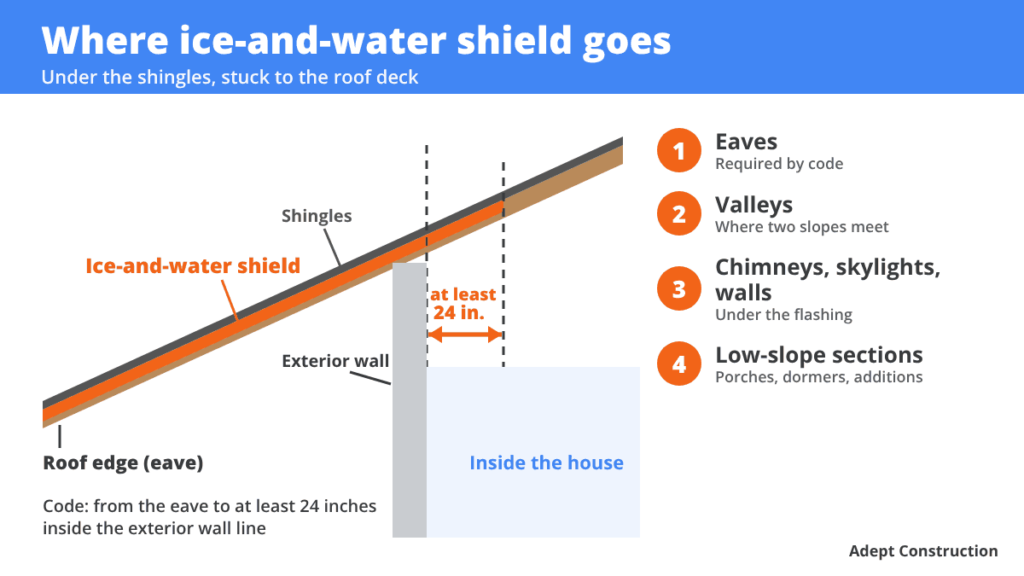
- What the code says: at the eaves it must run from the roof edge to at least 24 inches inside the exterior wall of the house.
- When it goes on: during a roof replacement. It sits on the bare deck, so it can’t be added without removing the shingles above it.
What ice-and-water shield is
Most of a roof deck is covered with regular underlayment, a lightweight synthetic sheet that is nailed down and sheds water as it runs downhill. It works well as long as water keeps moving. It is not built to hold back water that sits still or flows the wrong way.
Ice-and-water shield is different. It has a peel-off backing and a layer of rubberized asphalt that sticks straight to the plywood or OSB. When a roofing nail goes through it, the membrane squeezes tight around the nail shank, so water can’t follow the nail down into the deck. The building code calls it a “self-adhering polymer-modified bitumen sheet.” Roofers call it ice-and-water, ice guard or leak barrier, depending on the brand.
Why Chicago-suburb roofs need it
Our winters do two things that regular underlayment can’t handle. First, snow melts on the warm upper part of the roof and refreezes at the cold eaves, building an ice dam. Water pools behind that ridge of ice and creeps uphill under the shingles. Our guide to ice dams on Chicago-suburb roofs explains why they form and how to stop them at the source.
Winter storm warnings for DuPage County come from the National Weather Service Chicago office in Romeoville. Its winter weather page posts local snowfall and ice reports, which show how much snow can sit on a roof here before the next thaw.
Second, spring and summer storms throw wind-driven rain sideways into valleys and around chimneys, where it can work under shingle edges. In both cases the water is moving in a direction a normal roof was never meant to shed, and the membrane is what keeps it off the wood.
Where your roof needs ice-and-water shield
1. Along the eaves
This is the one the code spells out. The 2021 International Residential Code, which Downers Grove enforces, says the ice barrier must “extend from the lowest edges of all roof surfaces to a point not less than 24 inches inside the exterior wall line of the building” (IRC Section R905.1.2). On steep roofs, 8 in 12 or steeper, it must also reach at least 36 inches up the slope from the eave. Naperville uses the 2024 edition of the same code, according to the City of Naperville building permits page. The city does not require a permit for an asphalt shingle re-roof as long as the existing roof sheathing stays in place, but the work still has to meet code.
The rule is measured from the wall, not the roof edge. A house with a deep overhang needs more membrane than one with a short overhang, and on some homes that means a second row. It is worth asking a roofer how they will measure yours.
2. In every valley
A valley is the trough where two roof slopes meet. It carries more water than any other part of the roof, and it is where leaves and snow pile up. Running ice-and-water shield the full length of each valley before the valley shingles or metal go on gives that water a second line of defense.
3. Around chimneys, skylights and walls
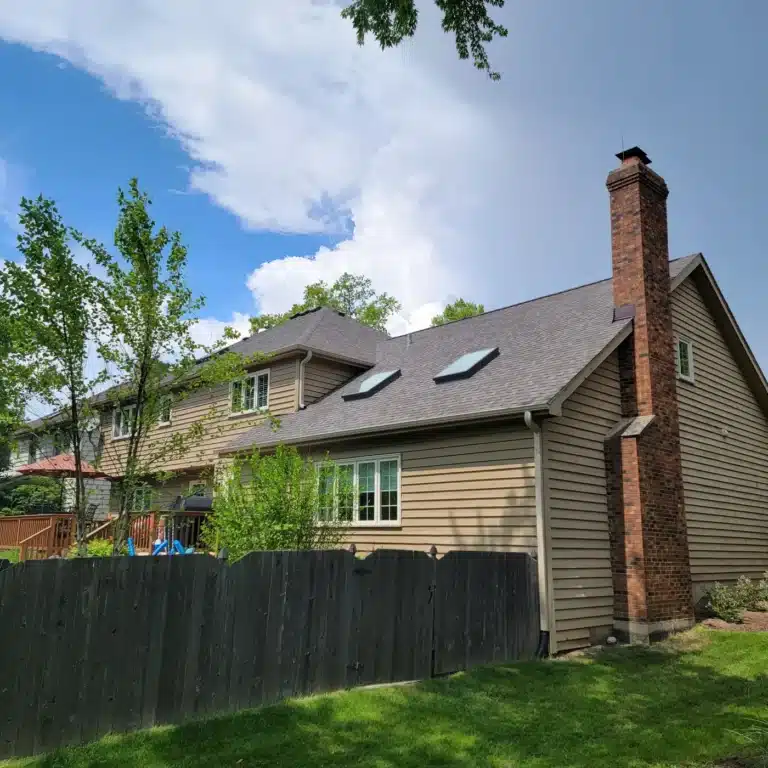
Anywhere the roof meets something else, the seal depends on flashing. Many roofers add a strip of membrane under the flashing around chimneys, skylights and the line where a roof runs into a wall, so a small gap in the metal does not turn into a ceiling stain. If your roof has a skylight, like this Naperville roof replacement with skylights, ask how the area around it will be protected.
4. Low-slope sections
Porch roofs, dormers and additions with a gentle pitch drain slowly, so water has more time to find a way in. These areas need extra protection under the shingles. Sections that are close to flat should not have shingles at all; they need a membrane system like the ones on our flat roofing page.
What ice-and-water shield doesn’t do
It does not stop an ice dam from forming. It only keeps the water behind the dam off the deck, and only where the membrane reaches. The real fix for ice dams is keeping heat out of the attic with air sealing, insulation and ventilation.
It also can’t be added later from the top. Because it sticks to the bare deck, the shingles have to come off first. That is why the time to get it right is the roof replacement, and why a full tear-off matters: it lets the crew see the deck and put the membrane where it belongs.
Questions to ask on a roof replacement estimate
- Where will the ice-and-water shield go? Eaves only, or eaves, valleys and around penetrations too?
- How far up from the eave will it run? The answer should be measured to at least 24 inches inside your exterior walls.
- Is this a full tear-off to the deck? A roof-over can’t get new membrane on the deck, and the code does not allow one where two or more layers already exist.
- Will the flashing be replaced? New step and chimney flashing goes hand in hand with new membrane.
- Is drip edge included, and in what order? Downers Grove’s re-roof memo says underlayment goes over the drip edge at the eaves and under it along the rakes (Village of Downers Grove re-roof requirements).
How Adept Construction handles it
On every shingle roof replacement, Adept Construction tears off to the deck, runs a self-adhering ice-and-water membrane from the roof edge to at least 24 inches inside the exterior wall, and lays it along every eave and valley. Synthetic underlayment covers the rest of the deck, with new step and chimney flashing and drip edge at the eaves and rakes. You can see the full install sequence on our asphalt shingle roofing page, and what a replacement involves on our roof replacement page.
If you live near one of our offices, start with our Naperville roof replacement, Downers Grove roof replacement or Villa Park roof replacement page. If water is already coming in, our roof leak repair team can find where.
Ice-and-water shield FAQs
Do all roofs need ice-and-water shield?
In the Chicago area, shingle roofs need an ice barrier along the eaves under the building code, because the region has a history of ice dams. Valleys and the areas around chimneys and skylights are not always required by code, but they are common leak points and many roofers protect them too.
How far up the roof does ice-and-water shield go?
At the eaves, the code requires it from the roof edge to at least 24 inches inside the exterior wall line. On roofs that are 8 in 12 or steeper, it must also reach at least 36 inches up the slope. Homes with deep overhangs may need more than one row to meet the 24-inch rule.
Can ice-and-water shield be added without replacing the roof?
No. The membrane sticks directly to the roof deck, so the shingles over that area have to come off first. It is normally installed during a full roof replacement.
Is ice-and-water shield the same as underlayment?
It is a type of underlayment, but a different kind. Regular synthetic underlayment is nailed down and sheds running water. Ice-and-water shield is self-adhering, seals around nails and holds back water that pools or backs up, which is why it is used at the eaves and valleys.
Does ice-and-water shield stop ice dams?
No. It keeps water that backs up behind an ice dam from reaching the deck, but the dam still forms. Stopping ice dams means keeping heat out of the attic with air sealing, insulation and good ventilation.
Not sure what’s under your shingles?
If you are planning a roof replacement or seeing stains near your outside walls after a thaw, Adept Construction will check your roof for free and show you what we find. Book a free roof inspection or request a free estimate.
Adept Construction, 27W225 79th St, Naperville, IL 60565, (630) 360-2730. Also at 6509 Hathaway Ln, Downers Grove, IL 60516, (630) 964-8708, and 300 E. Plymouth St., Villa Park, IL 60181, (630) 782-9736. Call our main line at (630) 360-2730 or book your free roof inspection.