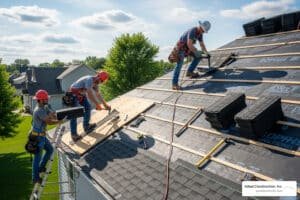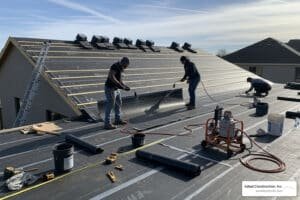

Why Cedar Shingle Siding Is Still One of the Best Choices for Your Home
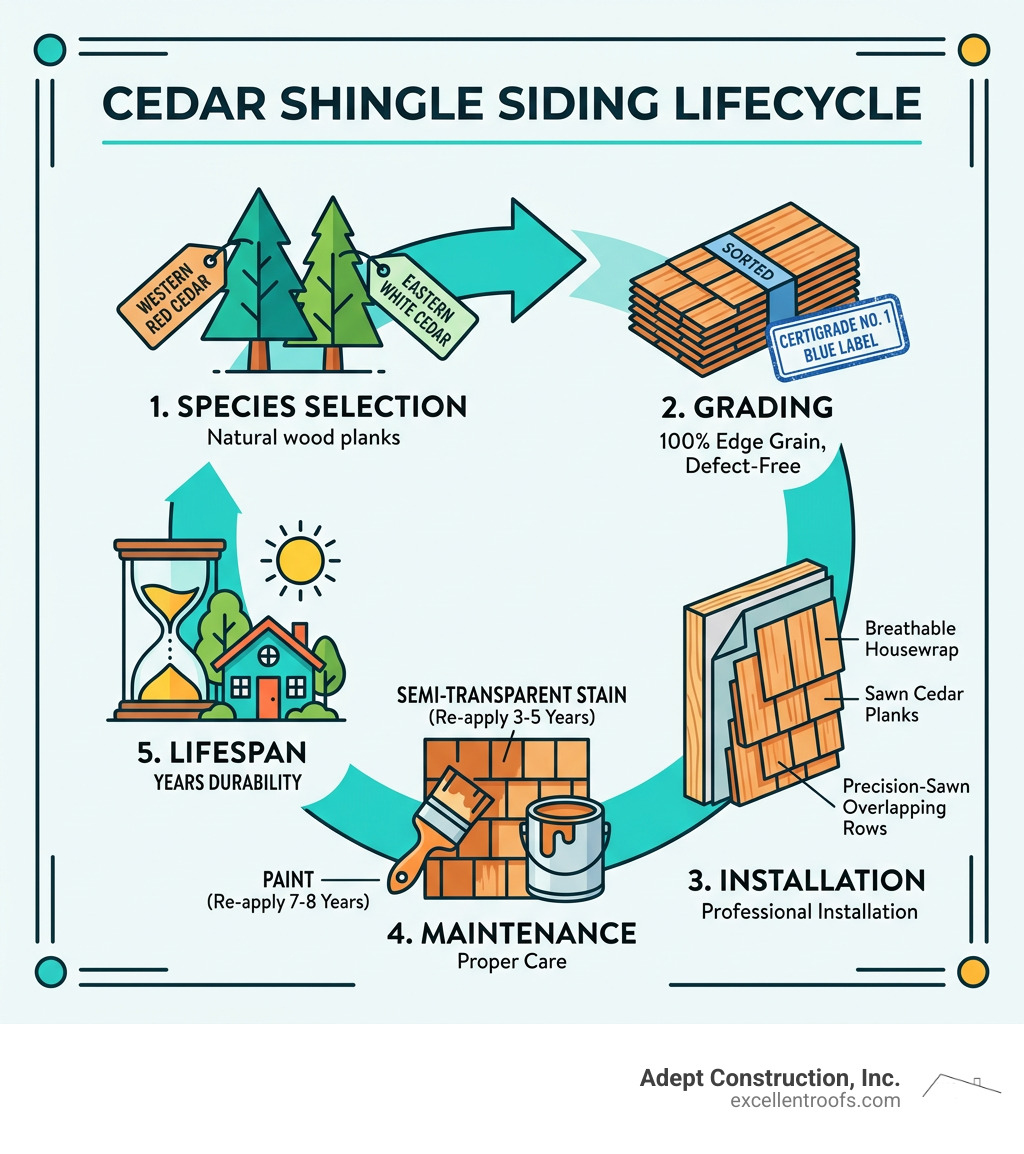
Cedar shingle siding is a natural wood cladding system made from precision-sawn cedar planks, installed in overlapping rows to protect and beautify the exterior walls of a home. Here’s a quick snapshot of what you need to know:
| Feature | Detail |
|---|---|
| Material | Western Red Cedar or Eastern White Cedar |
| Lifespan | 30–50+ years with proper maintenance |
| Best finish | Semi-transparent stain (lasts 3–5 years) or paint (7–8 years) |
| Top grade | Certigrade® No. 1 Blue Label — 100% edge grain, defect-free |
| Insulation | Up to double the R-value of bitumen-based products |
| Sustainability | Renewable, biodegradable, low carbon footprint |
| Cost driver | Material grade, labor, and local climate conditions |
Only about 13% of homes today are sided with wood — yet cedar remains a top choice for homeowners who want expert roofing and exterior services that deliver lasting curb appeal and real performance.
Cedar has been used on American homes since colonial times. It’s not a trend. It’s a proven, time-tested material that combines natural beauty with genuine durability. Whether you’re renovating a Cape Cod in Naperville or updating a ranch home in Downers Grove, cedar shingle siding adds architectural character that synthetic materials struggle to replicate.
I’m Gerald Michaels, founder of Adept Construction, Inc., and with nearly 30 years of hands-on experience installing and replacing cedar shingle siding across Chicago’s western suburbs, I’ve seen what separates a long-lasting installation from one that fails in under a decade. If you’d like a professional opinion on your own home, we offer free estimates — so don’t hesitate to reach out before making any decisions.
Understanding Cedar Shingle Siding: Types, Grades, and Shakes
When we talk to homeowners in Naperville and Downers Grove, the first point of confusion is usually the terminology. People often use “shingle” and “shake” interchangeably, but in cedar shake roofing and siding, they are distinct products with different manufacturing processes and visual outcomes.
Difference Between Shingles and Shakes
The primary difference between a cedar shingle and a cedar shake is the texture and uniformity. Cedar shingles are precision-sawn on both sides. This creates a uniform thickness and a smooth, tailored surface that lies flat against the wall. They are the go-to choice for a “polished” or contemporary look.
In contrast, cedar shakes are typically hand-split or machine-split, which reveals the natural, rugged grain of the wood. Shakes are thicker and more irregular, offering a rustic, heavy-textured aesthetic. While shakes are primarily used for roofing, they are sometimes used on sidewalls for a specific “lodge” or “cottage” feel. For most residential siding projects, however, the shingle – cedar – wood siding is the standard.
Western Red Cedar vs. Eastern White Cedar
Choosing the right species is critical for the long-term health of your home’s exterior.
- Western Red Cedar: This is the heavyweight champion of durability. It contains high levels of tannic acid, which acts as a natural preservative against rot and insects. It is dimensionally stable and resists warping. However, that same tannic acid can “bleed” through light-colored paints, so we generally recommend staining Western Red Cedar.
- Eastern White Cedar: This species is incredibly popular on the East Coast but also finds its way into our Illinois neighborhoods. It lacks the heavy tannic acid of its Western cousin, making Eastern White Cedar wood shingle siding the ideal candidate for painting. It naturally weathers to a beautiful, classic silver-gray patina if left untreated.
Grading and Quality Classes
Not all cedar is created equal. The Cedar Shake & Shingle Bureau (CSSB) sets the industry standards.
- Certigrade® Blue Label (No. 1 Grade): This is the highest quality available. These shingles are 100% edge grain, 100% clear heartwood, and 100% defect-free. When we perform a roof replacement in Downers Grove, this is the grade we insist on for maximum longevity.
- Red Label (No. 2 Grade): These allow for some minor imperfections and flat grain. While they are acceptable for some applications, they are more prone to curling and splitting over time.
- Black Label (No. 3 Grade): An economy grade intended for utility sheds or undercoursing. We do not recommend these for the primary siding of your home.
You can learn more about these standards directly from the Certigrade® Shingles – Cedar Shake & Shingle Bureau.
Key Benefits of Choosing Cedar Shingle Siding
Why choose wood in an age of plastic and fiber cement? For us, it comes down to three things: performance, planet, and prestige.
Durability and Long-Term Lifespan
A common myth is that wood siding rots away in a few years. In reality, cedar shingles have a lifespan of over 50 years when properly maintained. The natural oils in the wood are toxic to decay-causing fungi and wood-boring insects. Furthermore, cedar is incredibly stable; it doesn’t shrink or swell as much as other woods, which prevents the “buckling” you see in cheaper siding materials. We often discuss extending siding lifespan with our clients to ensure they get the full half-century of value out of their investment.
Environmental Sustainability and Insulation
Cedar is one of the most eco-friendly building materials on earth. It is a truly renewable resource with one of the lowest carbon footprints of any cladding material. Unlike vinyl, which is petroleum-based, cedar is biodegradable.
From a performance standpoint, cedar’s cellular structure is filled with air pockets, giving it a natural R-value that is up to double that of bitumen or asphalt-based products. This means natural cedar wood shingle siding helps keep your home warmer in the winter and cooler in our humid Illinois summers.
Aesthetic Versatility and Home Value
There is an “architectural soul” to cedar that machines can’t replicate. Whether you’re aiming for a traditional New England Cape Cod or a modern ranch, cedar shingles provide a depth of texture and shadow lines that increase your home’s resale value. In fact, many buyers in affluent areas like Hinsdale and Naperville specifically look for real wood exteriors. If you are considering an upgrade, check out our guide on cedar siding installation in Naperville.
How to Install Cedar Shingle Siding Properly
Installation is where most “DIY” projects go south. Cedar shingle siding requires precision to ensure it remains watertight and allows for the wood’s natural movement.
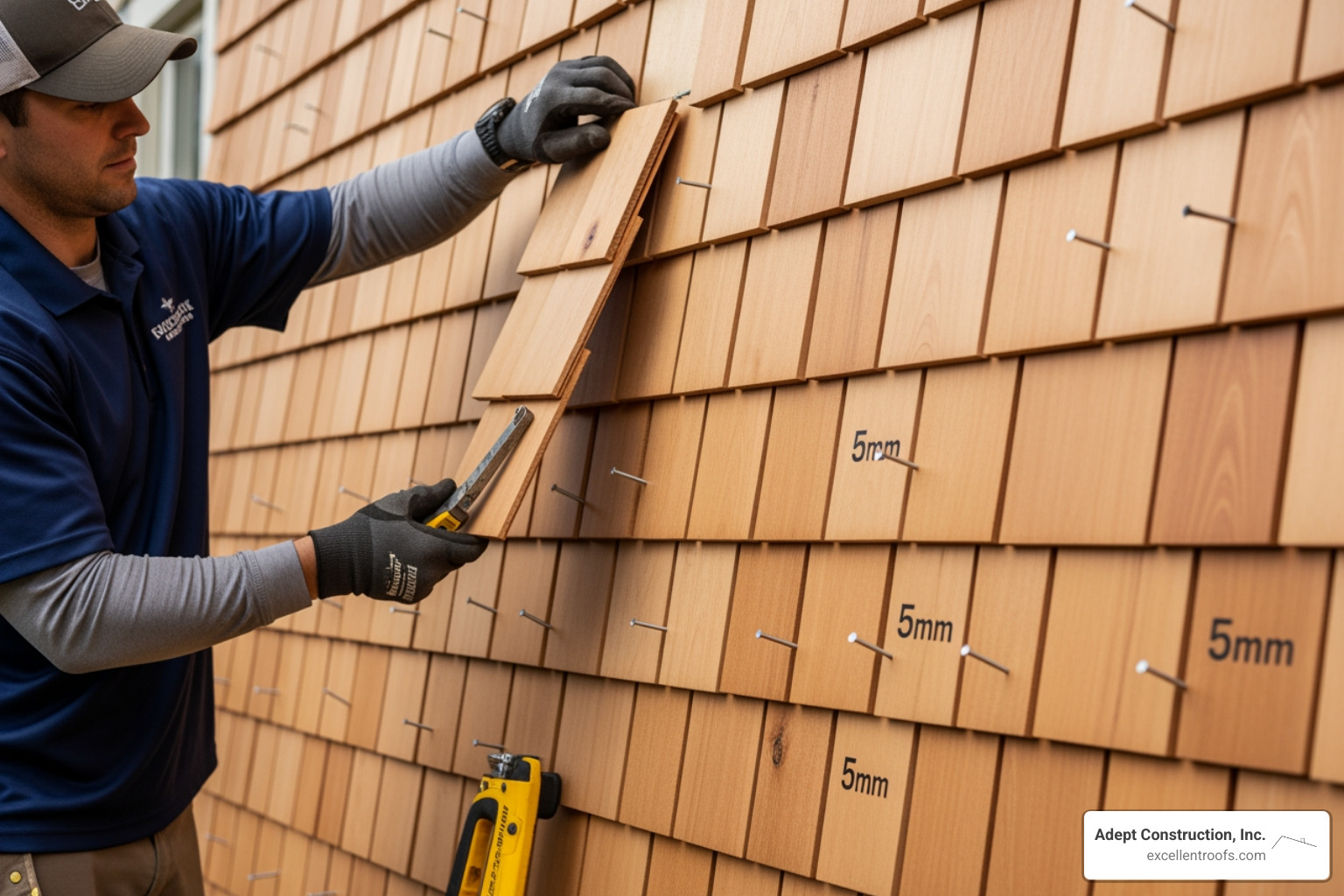
Tools and Materials for Installation
To do the job right, you need the correct fasteners. We always use stainless steel ring-shank nails or silicon bronze nails. Why? Because galvanized nails will eventually react with the cedar’s natural acids, leaving ugly black streaks (tannin bleeds) down your beautiful new siding.
You’ll also need:
- A breathable waterproof underlay (membrane).
- A chalk line for keeping rows straight.
- A spirit level for the starter course.
- A high-quality siding nailer or a traditional hammer.
Proper preparation is key for Downers Grove siding projects, especially given our region’s heavy rain and snow cycles. We follow a detailed process for installing cedar shingle siding that includes a double starter course at the bottom to ensure moisture doesn’t creep behind the first layer.
Calculating Quantity and Coverage
Calculating how much cedar you need involves more than just measuring the square footage of your walls. You have to account for the “exposure”—the portion of the shingle that is actually visible to the weather.
For a standard 16-inch shingle, a common exposure is 5 inches for roofing, but for siding (sidewalls), you can often go up to 7 or 7.5 inches. Each pack of 16-inch Cedar Shingles (Blue Label) typically covers about 2.32m² (roughly 25 square feet) at a standard exposure.
| Shingle Length | Max Sidewall Exposure (Single Course) | Approx. Coverage per Bundle |
|---|---|---|
| 16-inch | 7.5 inches | 25 sq. ft. |
| 18-inch | 8.5 inches | 33 sq. ft. |
| 24-inch | 11.5 inches | 40 sq. ft. |
Note: Always factor in a 10-15% waste factor for cuts around windows, doors, and corners. For a detailed breakdown of costs, see our article on cedar shake siding installation cost.
Maintenance and Weathering of Cedar Siding
Cedar is “low maintenance,” not “no maintenance.” If you leave cedar untreated, it will eventually weather. Western Red Cedar tends to turn a dark brown or blackish-gray, while Eastern White Cedar turns a beautiful silver-gray. However, uneven weathering can lead to a “blotchy” look, especially on sides of the house that get less sun.
Staining vs. Painting Cedar
This is the big debate.
- Staining: We almost always recommend a semi-transparent stain. It allows the wood to “breathe” and showcases the natural grain. A good stain will last 3–5 years. Because it doesn’t form a hard film, it won’t peel; it just fades, making the next coat much easier to apply.
- Painting: Paint provides a thick barrier against the sun and can last 7–8 years. However, if moisture gets behind the paint, it will bubble and peel. Furthermore, Western Red Cedar requires a high-quality oil-based primer to prevent tannin bleed-through.
If you’re unsure which is right for your siding installation in Naperville, we can show you samples of how both age in our local climate.
Common Mistakes to Avoid
In our years as roofers and siding near me in Downers Grove, we’ve seen these three mistakes more than any others:
- Over-driving nails: If you sink the nail head into the wood, you create a small “cup” that holds water, leading to rot. Nails should be driven flush.
- Improper joint offset: You must stagger the joints between shingles by at least 1.5 inches. If joints align across courses, water will find a direct path to your sheathing.
- Lack of expansion gaps: You must leave about a 5mm (1/4 inch) gap between shingles. Wood expands when it gets wet. If you butt them tight, the siding will buckle and pop off the wall.
Cedar Shingle Siding vs. Modern Alternatives
We often get asked how real cedar compares to vinyl siding or polymer “cedar impressions.”
Polymer and Vinyl Cedar Impressions
Modern technology has come a long way. Polymer shingles use real wood molds to replicate grain and texture. They offer excellent color consistency and require almost zero maintenance—just a power wash now and then. For many, cedar siding for the modern homeowner means choosing these high-performance replicas to avoid the 5-year staining cycle.
However, even the best vinyl lacks the “heft” and R-value of real wood. It can also crack in extreme cold or melt if a grill is placed too close to the wall.
Cost Factors and Regional Considerations
In the Chicago area, real cedar is a premium product. The material cost is higher than vinyl, and the labor is more intensive because each shingle is handled individually. However, when you consider the 50-year lifespan and the energy savings from insulation, the “cost per year” is often lower than cheaper materials that need replacement every 15–20 years.
When choosing roofing and siding companies in Naperville, IL, ensure they understand local building codes regarding fire ratings. In some high-density areas, you may be required to use fire-retardant treated (Certi-Guard®) shingles.
Frequently Asked Questions about Cedar Shingle Siding
How long does cedar shingle siding last?
Under normal conditions with routine maintenance, cedar shingle siding will last 30 to 50 years. Some historic homes in New England still feature original cedar shingles that are over a century old, though those are rare exceptions. The key is keeping the wood dry and free of debris like leaves or moss. You can learn more about general siding longevity in our other guides.
Should I stain or paint my cedar shingles?
We generally recommend staining. It preserves the natural look and prevents the peeling issues associated with paint. If you want a solid color, use a solid-body stain rather than paint; it looks like paint but acts like a stain, allowing moisture to escape the wood. For more tips, read our post on how to extend the lifespan of your siding.
What is the best grade of cedar for siding?
Always look for Certigrade® No. 1 Blue Label. It is 100% edge grain, which means the wood is cut perpendicular to the growth rings. This makes the shingle much more stable and less likely to “cup” or “twist” as it ages. Lower grades might save you money upfront, but they will cost you more in repairs later.
Conclusion
Choosing cedar shingle siding is an investment in your home’s future. It offers a combination of natural beauty, superior insulation, and environmental responsibility that few other materials can match. Whether you are in the heart of Naperville or a quiet neighborhood in Downers Grove, the right cedar siding can transform your home’s exterior into a masterpiece.
At Adept Construction, Inc., we take pride in our high-quality workmanship and our deep knowledge of wood siding systems. As a family-owned business, we treat every home as if it were our own. If you’re considering a roof replacement in Downers Grove or need a professional consultation on your siding, we are here to help.
We offer free estimates and honest advice to help you make the best decision for your property. Give us a call today or contact us through our website to schedule your consultation. Let’s build something beautiful together!